The IbiScript DSL
by Andrea Marruzzo

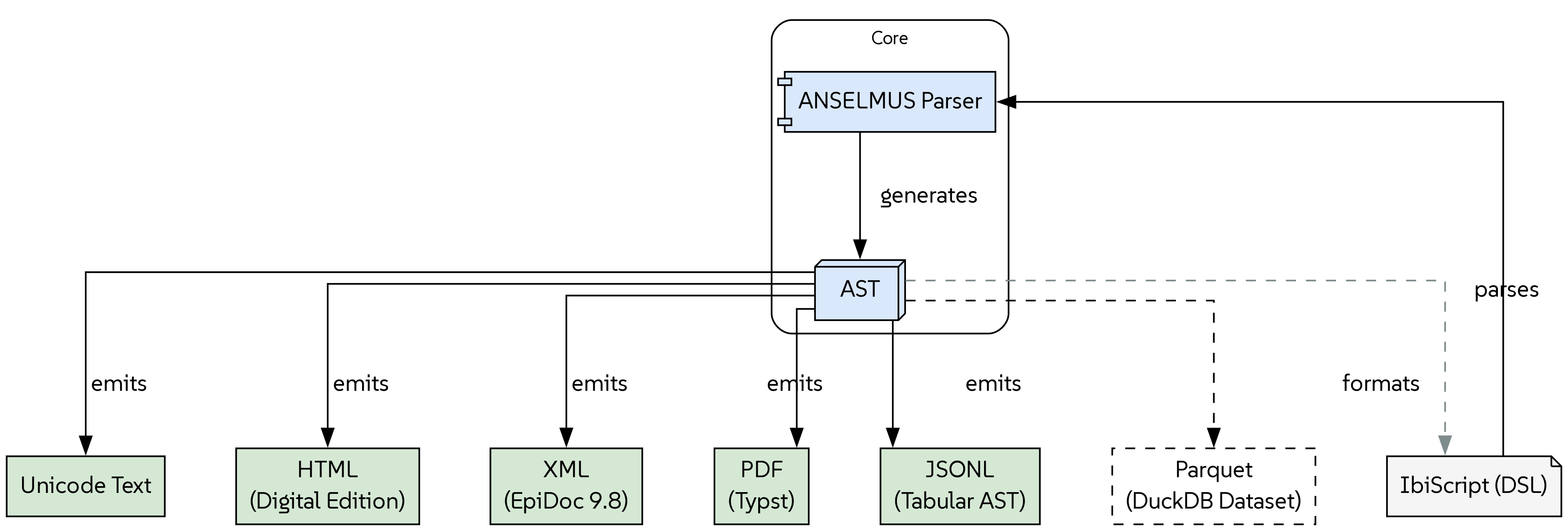
IbiScript is a domain-specific markup language for epigraphic and philological editing, designed to combine the agility of Leiden Conventions with the semantic precision of EpiDoc.
IbiScript gives the editor immediate control over the text. Developed in Rust and powered by the ANSELMUS parsing engine, it transforms the uncertainty of the artefact into solid digital data, acting as an architecture of thought that shapes the researcher’s epistemic contribution.
- Fluid Hermeneutics: Encode epigraphic phenomena and critical apparatus without the visual interference of XML tags.
- Technical Subsidiarity: Native generation of EpiDoc, HTML, JSONL, Typst PDF and Unicode outputs; full integration with the BEDA ecosystem via WebAssembly.
- Scientific Rigour: A bridge between the physicality of the artefact and a shared digital memory, where every character is a validated scientific thesis.
The name combines the sacred Ibis of Thoth, guardian of writing, with the Latin adverb ibi: to interrogate the word "there, in that place," upon the rough surface of ancient matter.
Notation Guide
This guide is organised according to the incremental logic of the ANSELMUS system, reflecting the transition from material data to editorial interpretation.
- Atomic Textual Units — Minimal units of textual segmentation that cannot contain or nest other notations within themselves.
- Phenomena — A set of notations designed to describe the state of the textual tradition, the condition of the support, and the variations that occurred during the genesis or transmission of the text.
- Critical and Editorial Apparatus — A set of notations for the meta-textual phenomena that constitute the philological analysis of the inscribed text. Includes assessments of epistemicity and interpretative plausibility, discursive critical apparatus notes, linguistic annotations, and bibliography.
- Formatting and Internal Annotation — Tools dedicated to managing typographic emphasis and inserting metatextual comments. Includes markers for graphic relief (bold, italics) and documentation features for internal use (line or block comments) not intended for the publication of the critical text.
Each phenomenon is documented atomically, systematically listing the combinations defined by the AST. However, for the sake of clarity, the treatment follows a maximum nesting depth of two levels: when phenomenon A may contain phenomenon B, the manual illustrates the case A(B) in the section dedicated to A, referring the reader to B's own section for a full account of what B may itself contain.
Unless otherwise stated, any phenomenon that admits internal content accepts all phenomena compatible with the physical/editorial distinction documented in each section.
General Guidelines
IbiScript is designed to be intuitive, flexible, and easily typed on standard European keyboards, while maintaining maximum compatibility with the established Leiden System.
Unless explicitly stated otherwise, the system’s parsing logic is agnostic to white spaces or line breaks. This makes IbiScript robust against minor formatting inconsistencies and, above all, prioritizes explicit semantic encoding over visual layout.
The notation is defined using a specific set of reserved Unicode characters (the STOP_SET sequence). To use any of these characters as literal text, an escaping mechanism is provided via the backslash \ character.
The question mark ? acts as a low certainty operator. While it generally indicates a doubtful interpretation by the editor, its specific meaning adapts to the phenomenological context: for instance, in the case of gaps, the ? operator shifts the description from an exact measurement to an approximate estimate.
Conversely, the exclamation mark ! acts as a high certainty or precision operator. It expresses a strong and definitive editorial assertion regarding the described phenomenon; in the context of measurements, the ! operator guarantees the pinpoint precision of the quantitative data provided, explicitly excluding any margin of approximation or executive uncertainty.
Some phenomena support an extended syntax for metadata, expressed
as a sequence of label:value pairs separated by semicolons. Values may
themselves contain plausibility notation, allowing the editor to express
graduated judgements over alternative readings — a feature documented in
detail in the plausibility assessment section (cf. Interpretative Plausibility Assessment) and referenced
in the sections of each phenomenon that supports it.
Atomic Textual Units
Minimal units of textual segmentation that cannot contain or nest other notations within themselves.
| Construct | Definition | General Reference |
|---|---|---|
Plain | Signs used in the critical text which do not constitute the notation of phenomena. | 🔎 Plain |
Whitespace | Significant white space within the text, whether isolated or occurring between epigraphic phenomena. | 🔎 Whitespace |
LineBreak | A line break within the text, optionally accompanied by explicit line numbering. | 🔎 LineBreak |
WordBreak | Indicates a word break, marking the exact point where a sequence of signs or a word is interrupted, such as by a line break or a physical fracture in the epigraphic medium. | 🔎 WordBreak |
WritingConv | Notations used to describe the writing conventions with which the text is written as a sequence of signs. | 🔎 WritingConv |
direction (LineFlow) | The direction of writing. | 🔎 direction (LineFlow) |
language (LangCode) | The language of the text or part of it. | 🔎 language (LangCode) |
writing_system (WsCode) | The writing system of the text or part of it. | 🔎 writing_system (WsCode) |
unit_separator (UnitSeparator) | The spatial or graphic element, if present, that separates text units. | 🔎 unit_separator (UnitSeparator) |
text_unit (TextUnit) | The type of textual unit separated by a spatial or graphic separator. | 🔎 text_unit (TextUnit) |
SectionBreak | Indicates that the following text is part of the subsection indicated by the notation. | 🔎 SectionBreak |
LexicalUnit | The logical boundary of a lexical unit (word). | 🔎 LexicalUnit |
As-Written Signs
Signs used in the critical text which do not constitute the notation of phenomena. IbiScript supports the native rendering of any Unicode character, but each writing system benefits in its own way from the various rendering options available.
| Construct | Definition | General Reference |
|---|---|---|
Plain (realized) | Textual signs rendered graphically within the text as Unicode glyphs. | 🔎 Plain |
Plai (coded) | Textual signs represented in the form of abstract notation. | 🔎 Whitespace |
Realised Signs
Textual signs rendered graphically within the text as Unicode glyphs.
Syntax
Any number of Unicode characters not in STOP_SET, i.e. those special characters used to notate other phenomena.
Overview
| Notation | Simplified AST | Paper Output |
|---|---|---|
𝑆×𝑁 | Plain(𝑆×𝑁) | 𝑆×𝑁 |
𝑆= any sign (Unicode character) ∉STOP_SET(cf. Technical Catalogue of Symbols) otherwise preceded by the escape character\.𝑁= number of characters (represented by char or digits).
Examples
| Notation | Paper Output |
|---|---|
| 𒀭𒂗𒆤 |
| 𓄤𓆑𓂋 |
| φῶς |
| 𐌀𐌕𐌉 |
| rēs |
| 𐭬𐭫𐭪 |
EpiDoc Outputs
| Notation | EpiDoc (XML) |
|---|---|
| |
| |
| |
| |
| |
| |
Structural Analysis (Conceptual AST)
| Notation | AST |
|---|---|
| |
| |
| |
| |
| |
| |
Whilst this input method is ideal for commonly used characters, it proves inadequate for rare glyphs or those belonging to historical writing systems. Indeed, the direct insertion of specific Unicode characters not only risks generating incorrect substitute characters if the font being used is incomplete, but also compromises the logical consistency of the editorial layout. This occurs in particular when introducing graphemes with opposing writing directions (as in the case of Middle Persian characters inserted into a Latin transcription), causing unpredictable alterations to the text layout.
Coded Signs
Textual signs represented in the form of abstract notation.
Syntax
- Any sequence of Unicode hexadecimal character codes separated by semicolons
;, enclosed in curly brackets{…}and preceded by the\ucommand. - Any sequence of text notation groups separated by semicolons
;, enclosed in curly brackets{…}and preceded by the command\u. Each text notation group consists of: - a four-letter ISO 15924 code identifying the writing system;
- a colon
:; - a single alias or a sequence of Unicode character aliases separated by commas
,(belonging to the same writing system as a group).
Overview
| Notation | Simplified AST | Paper Output |
|---|---|---|
\u{Cᵤ;…} | Plain(𝑆ᵤ×𝑁) | 𝑆ᵤ×𝑁 |
Cᵤ= Unicode codepoint.cₛ= four-letter ISO 15924 code of the writing system.a= Unicode character alias.𝑆ᵤ= any sign (Unicode character) obtained from the coded form.𝑁= number of characters (represented by char or digits).
Examples
| Notation | Paper Output |
|---|---|
| 𐹾 |
| 𐹾 |
| 𒀭𒂗𒆤 |
| 𓄤𓆑𓂋 |
| φῶς |
| 𐌀𐌕𐌉 |
| rēs |
| 𐭬𐭫𐭪 |
| श्री |
EpiDoc Outputs
| Notation | EpiDoc (XML) |
|---|---|
| |
| |
| |
| |
| |
| |
| |
| |
| |
Structural Analysis (Conceptual AST)
| Notation | AST |
|---|---|
| |
| |
| |
| |
| |
| |
| |
| |
| |
However, the most convenient and reliable input method is the key:value system, which IbiScript supports for 111 modern and historical writing systems (cf. Writing systems supported for key:value entry for the full list of codes). Each Unicode character can be referred to via one or more nominal aliases that correspond to the official character names, suitably stripped of superfluous elements; numerical forms, in particular, can also be written by directly using numeric digits (cf. example 2). It is not necessary to repeat the ISO 15924 code before each nominal alias (cf. examples 3–8), as the sequence is recognised automatically (cf. example 9 for a case of explicit repetition with optional spaces after the semicolons).
White Space
Significant white space within the text, whether isolated or occurring between epigraphic phenomena. The following rules define a white space as significant:
- isolated in plain text (cf. example 1).
- inserted in plain text between text blocks as a word separator (cf. example 2).
- inserted inside blocks of epigraphic phenomena or nested epigraphic phenomena (cf. example 3).
- inserted, even alone, inside an
Omittedphenomenon to express a deliberate omission of a white space by the scribe (cf. example 4). White spaces appearing before or after delimiters are not significant and are thus ignored, treated with laxity as editorial typos.
Syntax
Any white space character.
Overview
| Notation | Simplified AST | Paper Output |
|---|---|---|
| Whitespace | |
𝑊= any white space.
Examples
| Notation | Paper Output |
|---|---|
| |
| ab c |
| ab c |
|
EpiDoc Outputs
| Notation | EpiDoc (XML) |
|---|---|
| |
| |
| |
| |
Structural Analysis (Conceptual AST)
| Notation | AST |
|---|---|
| |
| |
| |
| |
Line Break
A line break within the text, optionally accompanied by explicit line numbering.
Standard "newline" characters are not evaluated as philologically significant line breaks; instead, they produce Newline units that are treated merely as notational noise. Simple carriage returns can therefore be used to format IbiScript code at will—for instance, by moving long sequences of linguistic annotations to the next line (cf. Linguistic Annotation of a Lexical Unit).
From an epigraphic perspective, IbiScript requires that every significant line of text—that is, any line clearly identifiable on the support—be explicitly marked in the code. This is achieved by appending the notation (illustrated below) at the end of the line, as if notifying the system of a carriage return by analogy.
Should the user forget to insert an explicit line break at the final line of text (e.g., in the case of single-line inscriptions), IbiScript will automatically supply it.
Syntax
A single slash / optionally followed by a natural number for explicit line numbering.
Overview
| Notation | Simplified AST | Paper Output |
|---|---|---|
/nᵟ | LineBreak(νₐᵟ) | / |
𝑛ᵟ= an optional number𝑛∈ ℕ (natural numbers).↵= a new lineνₐᵟ= any natural number or none.νₑᵟ=nEpiDoc attribute followed by a natural number or none.
Examples
| Notation | Paper Output |
|---|---|
| |
| |
| abc def |
| abc def |
EpiDoc Outputs
| Notation | EpiDoc (XML) |
|---|---|
| |
| |
| |
| |
Structural Analysis (Conceptual AST)
| Notation | AST |
|---|---|
| |
| |
| |
| |
Remarks
Since standard carriage returns (i.e., those inserted with the "Enter" key) are non-significant, inscriptions consisting of very short lines can be written on a single line of code, e.g., line1/line2/line3/.
Word Break
Indicates a word break, marking the exact point where a sequence of signs or a word is interrupted, such as by a line break or a physical fracture in the epigraphic medium.
This node solely describes a graphical or positional event and does not imply a linguistic division: the actual separation or categorisation of lexical units is instead managed using the specific notation provided by LexicalUnit.
Syntax
A hyphen -.
Overview
| Notation | Simplified AST | Paper Output |
|---|---|---|
- | WordBreak | - |
Examples
| Notation | Paper Output |
|---|---|
| - |
| -abc |
| abc- |
| ab-c |
EpiDoc Outputs
| Notation | EpiDoc (XML) |
|---|---|
| |
| |
| |
| |
Structural Analysis (Conceptual AST)
| Notation | AST |
|---|---|
| |
| |
| |
| |
Writing Conventions
Notations used to describe the writing conventions with which the text is written as a sequence of signs.
All of the following notations share the same delimiter that generally indicates metadata notations, the dollar sign $, and can therefore be grouped within the delimiters separated by semicolons ;.
Delimiters
| Side | Sign | Name | Unicode |
|---|---|---|---|
| Left | $ | Dollar Sign | U+0024 |
| Right | $ | Dollar Sign | U+0024 |
$abc$ ↓ Formatter optimisation for human legibility ↓ $abc$ |
|---|
| Side | Sign | Name | Unicode |
|---|---|---|---|
| Left | $ | Dollar Sign | U+0024 |
| Right | $ | Dollar Sign | U+0024 |
| Construct | Definition | General Reference |
|---|---|---|
direction (LineFlow) | The direction of writing. | 🔎 direction (LineFlow) |
language (LangCode) | The language of the text or part of it. | 🔎 language (LangCode) |
writing_system (WsCode) | The writing system of the text or part of it. | 🔎 writing_system (WsCode) |
unit_separator (UnitSeparator) | The spatial or graphic element, if present, that separates text units. | 🔎 unit_separator (UnitSeparator) |
text_unit (TextUnit) | The type of textual unit separated by a spatial or graphic separator. | 🔎 text_unit (TextUnit) |
Text Direction
The direction of writing.
Syntax
A hyphen - followed by the greater-than sign > for the rightward arrow, or a hyphen - preceded by the less-than sign < for the leftward arrow, enclosed within the dollar-sign wrapper $…$.
Overview
| Notation | Simplified AST | Paper Output |
|---|---|---|
$->$ | WritingConv{direction: LineFlow(LeftToRight), …} | → |
Examples
| Notation | Paper Output |
|---|---|
| abc |
| 𐭠𐭡𐭢 |
EpiDoc Outputs
| Notation | EpiDoc (XML) |
|---|---|
| |
| |
Structural Analysis (Conceptual AST)
| Notation | AST |
|---|---|
| |
| |
Text Language
The language of the text or part of it.
Syntax
Any valid metadata key referring to the language followed by an equal sign = and a valid ISO 639 language code, enclosed within dollar signs $…$.
Overview
| Notation | Simplified AST | Paper Output |
|---|---|---|
$kₘ=Cᵢ$ | WritingConv{language: LangCode(Cᵥ), …} |
kₘ= any valid metadata key (listed below).Cᵢ= ISO 639 language code.Cᵥ= validated code.
Supported Metadata Keys and Values
| Key | Meaning | Formatting | Minification |
|---|---|---|---|
language, lang, l | language | lang | l |
Examples
| Notation | Paper Output |
|---|---|
| abc |
| 𐭠𐭡𐭢 |
EpiDoc Outputs
| Notation | EpiDoc (XML) |
|---|---|
| |
| |
Structural Analysis (Conceptual AST)
| Notation | AST |
|---|---|
| |
| |
Writing System
The writing system of the text or part of it.
Why specify the writing system separately from the language, as is done in EpiDoc (IETF BCP 47 standard)? Because the identity of the writing system does not correspond to linguistic identity.
Syntax
Any valid metadata key referring to the writing system followed by an equal sign = and a valid ISO 15924 writing system code, enclosed within dollar signs $…$.
Overview
| Notation | Simplified AST | Paper Output |
|---|---|---|
$kₘ=Cᵢ$ | WritingConv{writing_system: WsCode(Cᵥ), …} |
kₘ= any valid metadata key (listed below).Cᵢ= ISO 15924 writing system code.Cᵥ= validated code.
Supported Metadata Keys and Values
| Key | Meaning | Formatting | Minification |
|---|---|---|---|
writing_system, ws | writing system | ws | ws |
Examples
| Notation | Paper Output |
|---|---|
| abc |
| 𐭠𐭡𐭢 |
EpiDoc Outputs
| Notation | EpiDoc (XML) |
|---|---|
| |
| |
Structural Analysis (Conceptual AST)
| Notation | AST |
|---|---|
| |
| |
Text Unit Separator
The spatial or graphic element, if present, that separates text units.
The value space indicates that the separator is a space or a space character; continuous indicates the absence of a separator (scriptio continua).
In cases where the separator is a symbol, it is possible to enter an approximation of it (e.g. a Unicode character that resembles it as closely as possible) and, optionally, its taxonomic classification.
Syntax
Any valid metadata key indicating the unit separator, followed by an equal sign = and any Unicode text, including spaces, representing the spatial/graphic unit approximation. Optionally, preceded by a colon :, a taxonomic value can be specified from among those supported or a custom one.
Overview
| Notation | Simplified AST | Paper Output |
|---|---|---|
$kₘ="α":sᵤ$ | WritingConv{unit_separator: UnitSeparator, …} |
kₘ= any valid metadata key (listed below).α= Unicode character approximation.sᵤ= textual unit separator.
Supported Metadata Keys and Values
| Key | Meaning | Formatting | Minification |
|---|---|---|---|
unit_separator, u_sep | unit separator | u_sep | u_sep |
space, sp | space | space | sp |
continuous, cont | continuous | continuous | cont |
Examples
| Notation | Paper Output |
|---|---|
| |
| |
|
EpiDoc Outputs
| Notation | EpiDoc (XML) |
|---|---|
| |
| |
| |
Structural Analysis (Conceptual AST)
| Notation | AST |
|---|---|
| |
| |
| |
Separated Text Unit
The type of textual unit separated by a spatial or graphic separator.
It allows to indicate the fundamental textual unit, that is, the division of a text into visible units (words, syllables, characters, etc.).
Syntax
Any valid metadata key used to identify the text unit, followed by an equal sign = and a taxonomic string intended to describe the text unit.
Overview
| Notation | Simplified AST | Paper Output |
|---|---|---|
$kₘ=uₜ$ | WritingConv{text_unit: TextUnit(uₜ), …} |
kₘ= any valid metadata key (listed below).uₜ= textual unit.
Supported Metadata Keys and Values
| Key | Meaning | Formatting | Minification |
|---|---|---|---|
text_unit, text_u, t_unit | text unit | text_u | text_u |
word, w | word | word | w |
syllable, syl | syllable | syl | syl |
character, char, chr | character | char | chr |
Examples
| Notation | Paper Output |
|---|---|
| |
| |
|
EpiDoc Outputs
| Notation | EpiDoc (XML) |
|---|---|
| |
| |
| |
Structural Analysis (Conceptual AST)
| Notation | AST |
|---|---|
| |
| |
| |
Text Subdivision
Indicates that the following text is part of the subsection indicated by the notation.
Syntax
Any valid metadata key (see below) followed by an equal sign =, a free-text identifier for the selected text subdivision, and an optional certainty notation, all enclosed in dollar signs $…$.
Overview
| Notation | Simplified AST | Paper Output |
|---|---|---|
$kₘ=iₚ‽ᵟ$ | SectionBreak {unit: Lᵥ, n: iₚ, cert: γ} | §iₚ |
kₘ= any valid metadata key (listed below).Lᵥ= validated level code (subdivision).iₚ= free text identifier of the subdivision.‽ᵟ∈ {?,!,ε} = uncertainty marker?, certainty marker!, or empty string (ε).γ∈ {Low,High,Medium} = certainty level corresponding to the marker used in the notation.◇ᵟ∈ {⯑,⯁,ε} = rendering of the uncertainty/certainty marker in the notation or empty string (ε).
Supported Metadata Keys and Values
| Key | Meaning | Formatting | Minification |
|---|---|---|---|
column, col, c | column | col | c |
line, ln, l | line | ln | l |
section, sec, sect, s | section | sect | s |
page, pag, p, pg | page | pag | p |
entry, n | entry | entry | n |
Examples
| Notation | Paper Output |
|---|---|
| abc |
| abc |
EpiDoc Outputs
| Notation | EpiDoc (XML) |
|---|---|
| |
| |
Structural Analysis (Conceptual AST)
| Notation | AST |
|---|---|
| |
| |
Lexical Unit Boundary
The logical boundary of a lexical unit (word). It is used to mark the end of a word regardless of its physical layout on the support, allowing the system to reconstruct units split by fractures or line breaks.
Syntax
Any number of Unicode characters enclosed within ampersands &…&. Optionally, linguistic annotations can follow after a semicolon ;.
If the user wishes to easily identify a series of lexical units, the entire sequence can be enclosed within ampersands &…& with individual units separated by a forward slash /.
Overview
| Notation | Simplified AST | Paper Output |
|---|---|---|
&𝑆×𝑁;λₛ=λᵥ;…& | LexicalUnit([𝘜], LinguisticAnalysis{λₖ:λᵥ, …}) | 𝑆×𝑁 |
𝑆= any sign (Unicode character) ∉STOP_SET(cf. Technical Catalogue of Symbols) otherwise preceded by the escape character\.𝑁= number of characters (represented by char or digits).λₛ= label, which may also be in abbreviated form, for linguistic annotation.λᵥ= value of the linguistic annotation (plausibility scale).λₖ= canonical key for the linguistic annotation derived from the corresponding label.
Examples
| Notation | Paper Output |
|---|---|
| ab-c |
| ab c |
| abc defg hijk l |
| abcdefhijk |
EpiDoc Outputs
| Notation | EpiDoc (XML) |
|---|---|
| |
| |
| |
| |
Structural Analysis (Conceptual AST)
| Notation | AST |
|---|---|
| |
| |
| |
| |
Phenomena
A set of notations designed to describe the state of the textual tradition, the condition of the support, and the variations that occurred during the genesis or transmission of the text.
| Construct | Definition | General Reference |
|---|---|---|
Vacat | A space intentionally left empty by the inscriber of the text, not due to a loss of the support, but for purposes of layout or textual distinction. | 🔎 Plain |
Gap | Physical losses of the support that resulted in the disappearance of portions of the original text; the extent of the loss can be certain, estimated, or unknown. | 🔎 Gap |
Fracture | Breaks in the inscribed support, with the Fracture indicated after which the text is present, without providing any details about the text that follows. | 🔎 Fracture |
Unclear | Signs remaining on the support but difficult to read due to physical degradation or poor preservation. | 🔎 Unclear |
Supplied | Signs no longer visible or never inscribed, critically restored by the editor to recover the meaning of the text. | 🔎 Supplied |
PreviousSeen | Signs, gaps, or epigraphic phenomena no longer visible through direct autopsy on the support, but documented in earlier scholarly editions or notebooks. | 🔎 PreviousSeen |
Omitted | Signs, white spaces, or line breaks added by the editor because the inscriber of the text either omitted them or mistakenly inscribed other characters in their place. | 🔎 Omitted |
Surplus | Signs inscribed by error which the editor considers should not be part of the text and are therefore expunged. | 🔎 Surplus |
Erasure | Signs or portions of text intentionally removed from the support in antiquity by scraping or chiselling. | 🔎 Erasure |
Addition | Signs, words, or portions of text added to the support at a later time than the original drafting, often by a different hand. | 🔎 Addition |
Correction | Corrective interventions on the support consisting in the erasure of pre-existing signs and their replacement with new ones, carried out at a later time than the original drafting, often by a different hand. | 🔎 Correction |
Ligature | Two or more letters whose strokes have been merged or joined by the inscriber into a single graphic sign, usually sharing a common stem. | 🔎 Ligature |
Abbreviation | Phenomena relating to words or formulas abbreviated by the inscriber, including abbreviation marks, omitted letters, and the critical expansion (or resolution) provided by the editor. | 🔎 Abbreviation |
LexicalUnit | #logogram-meta.desc | 🔎 LexicalUnit |
Vacat
A space intentionally left empty by the inscriber of the text, not due to a loss of the support, but for purposes of layout or textual distinction.
Delimiters
| Side | Sign | Name | Unicode |
|---|---|---|---|
| Left | [ | Left Square Bracket | U+005B |
| Right | ] | Right Square Bracket | U+005D |
| Construct | Definition | General Reference |
|---|---|---|
Vacat-Char | Uninscribed signs or spaces. | 🔎 Plain |
Vacat-Line | A line break within the text, optionally accompanied by explicit line numbering. | 🔎 Whitespace |
Uninscribed Signs or Spaces (v. or vac.)
Uninscribed signs or spaces.
Syntax
The greather-than sign > followed by the letter c for "character" and a number corresponding to the character count (followed by the optional precision notation), the whole enclosed within square brackets […].
Overview
| Notation | Simplified AST | Paper Output |
|---|---|---|
[>cN‽ᵟ] | Vacat{count: n, unit: Char, precision: γ} | vac. char. n◇ᵟ |
𝑛∈ ℕ (natural numbers).‽ᵟ∈ {?,!,ε} = uncertainty marker?, certainty marker!, or empty string (ε).◇ᵟ∈ {⯑,⯁,ε} = rendering of the uncertainty/certainty marker in the notation or empty string (ε).γ∈ {Low,High,Medium} = certainty level corresponding to the marker used in the notation.𝑁= number of characters (represented by char or digits).
Examples
| Notation | Paper Output |
|---|---|
| vac. char. |
| vac. char. 3 |
| vac. char. 7 |
| vac. char. 5 |
EpiDoc Outputs
| Notation | EpiDoc (XML) |
|---|---|
| |
| |
| |
| |
Structural Analysis (Conceptual AST)
| Notation | AST |
|---|---|
| |
| |
| |
| |
Uninscribed Remainder of Line (vacat)
The uninscribed remainder of the line.
Syntax
The greather-than sign ! followed by the letter l for "line" and a number corresponding to the character count (followed by the optional precision notation), the whole enclosed within square brackets […].
Overview
| Notation | Simplified AST | Paper Output |
|---|---|---|
[>lN‽ᵟ] | Vacat{count: n, unit: Line, precision: γ} | vacat n◇ᵟ |
L= non-digit genitive plural of the Latin cardinal numeral corresponding toN.𝑛∈ ℕ (natural numbers).‽ᵟ∈ {?,!,ε} = uncertainty marker?, certainty marker!, or empty string (ε).◇ᵟ∈ {⯑,⯁,ε} = rendering of the uncertainty/certainty marker in the notation or empty string (ε).γ∈ {Low,High,Medium} = certainty level corresponding to the marker used in the notation.
Examples
| Notation | Paper Output |
|---|---|
| vac. lin. |
| vac. lin. 2 |
| vac. lin. 4 |
| vac. lin. 3 |
EpiDoc Outputs
| Notation | EpiDoc (XML) |
|---|---|
| |
| |
| |
| |
Structural Analysis (Conceptual AST)
| Notation | AST |
|---|---|
| |
| |
| |
| |
Gaps
Physical losses of the support that resulted in the disappearance of portions of the original text; the extent of the loss can be certain, estimated, or unknown.
Delimiters
| Side | Sign | Name | Unicode |
|---|---|---|---|
| Left | [ | Left Square Bracket | U+005B |
| Right | ] | Right Square Bracket | U+005D |
| Construct | Definition | General Reference |
|---|---|---|
Gap-Known | A gap of known extent. The editor indicates a precise number of missing characters by repeating a gap sign inside square brackets. | 🔎 Plain |
Gap-Range | A gap whose extent is expressed as a plausible numeric range. | 🔎 Whitespace |
Gap-Unknown | A gap of unknown extent. | 🔎 Whitespace |
Gap of Known Extent
A gap of known extent. The editor indicates a precise number of missing characters by repeating a gap sign inside square brackets.
Syntax
Any natural number flanked by double full stops .…., followed by the optional precision notation the whole enclosed within square brackets […].
Overview
| Notation | Simplified AST | Paper Output |
|---|---|---|
[.𝑁.‽ᵟ] | Gap{quantity: Known{count: 𝑁}, precision: γ} | [·𝑁◇ᵟ·] |
𝑁= number of characters (represented by char or digits).𝑛∈ ℕ (natural numbers).‽ᵟ∈ {?,!,ε} = uncertainty marker?, certainty marker!, or empty string (ε).γ∈ {Low,High,Medium} = certainty level corresponding to the marker used in the notation.◇ᵟ∈ {⯑,⯁,ε} = rendering of the uncertainty/certainty marker in the notation or empty string (ε).
Examples
| Notation | Paper Output |
|---|---|
| 7 |
| .3. |
| .4. |
EpiDoc Outputs
| Notation | EpiDoc (XML) |
|---|---|
| |
| |
| |
Structural Analysis (Conceptual AST)
| Notation | AST |
|---|---|
| |
| |
| |
Gap of Ranged Extent
A gap whose extent is expressed as a plausible numeric range.
Syntax
Any natural numbers couple separated by an hyphen - (followed by the optional precision notation), enclosed between square brackets […].
Overview
| Notation | Simplified AST | Paper Output |
|---|---|---|
[𝑛₁-𝑛₂‽ᵟ] | Gap{quantity: Range{min: 𝑛₁, max: 𝑛₂}, precision: γ} | [·𝑛₁–𝑛₂◇ᵟ·] |
𝑛₁,𝑛₂∈ ℕ (natural numbers), with𝑛₁≤𝑛₂.𝑁= number of characters (represented by char or digits).𝑛∈ ℕ (natural numbers).‽ᵟ∈ {?,!,ε} = uncertainty marker?, certainty marker!, or empty string (ε).γ∈ {Low,High,Medium} = certainty level corresponding to the marker used in the notation.◇ᵟ∈ {⯑,⯁,ε} = rendering of the uncertainty/certainty marker in the notation or empty string (ε).
Examples
| Notation | Paper Output |
|---|---|
| 1–3 |
| 2–4 |
| 5–6 |
EpiDoc Outputs
| Notation | EpiDoc (XML) |
|---|---|
| |
| |
| |
Structural Analysis (Conceptual AST)
| Notation | AST |
|---|---|
| |
| |
| |
Gap of Unknown Extent
A gap of unknown extent.
Syntax
Zero or more white spaces enclosed between square brackets […].
Overview
| Notation | Simplified AST | Paper Output |
|---|---|---|
[𝑊×𝑁₀₋ₙ‽ᵟ] | Gap{quantity: Unknown, precision: γ} | [··◇ᵟ·] |
𝑊= any white space.𝑁₀₋ₙ= zero or more repetitions.‽ᵟ∈ {?,!,ε} = uncertainty marker?, certainty marker!, or empty string (ε).γ∈ {Low,High,Medium} = certainty level corresponding to the marker used in the notation.◇ᵟ∈ {⯑,⯁,ε} = rendering of the uncertainty/certainty marker in the notation or empty string (ε).
Examples
| Notation | Paper Output |
|---|---|
| · |
| · |
| · |
EpiDoc Outputs
| Notation | EpiDoc (XML) |
|---|---|
| |
| |
| |
Structural Analysis (Conceptual AST)
| Notation | AST |
|---|---|
| |
| |
| |
Fractures
Breaks in the inscribed support, with the Fracture indicated after which the text is present, without providing any details about the text that follows.
Syntax
- Left-hand fracture: the less-than sign
<enclosed within curly brackets{…}(cf. Example 1). - Right-hand fracture: the greater-than sign
>enclosed within curly brackets{…}(cf. Example 2). - Top fracture: the caret
^enclosed within curly brackets{…}(cf. Example 3). - Bottom fracture: the letter
venclosed within curly brackets{…}(cf. Example 4).
Overview
| Notation | Conceptual AST | Paper Output |
|---|---|---|
{<} | Fracture(Left) | ⊣ |
{>} | Fracture(Right) | ⊢ |
{^} | Fracture(Top) | ⟘ |
{V} | Fracture(Bottom) | ⟙ |
Unclear Signs
Signs remaining on the support but difficult to read due to physical degradation or poor preservation.
Delimiters
| Side | Sign | Name | Unicode |
|---|---|---|---|
| Left | * | Asterisk | U+002A |
| Right | * | Asterisk | U+002A |
*abc* ↓ Formatter optimisation for human legibility ↓ ⁎abc⁑ |
|---|
| Side | Sign | Name | Unicode |
|---|---|---|---|
| Left | ⁎ | Low Asterisk | U+204E |
| Right | ⁑ | Two Asterisks Aligned Vertically | U+2051 |
Internally Allowed Constructs
| Construct | Specific Reference | General Reference |
|---|---|---|
Plain | 📖 | 🔎 Plain |
Whitespace | — | 🔎 Whitespace |
Newline | — | 🔎 Newline |
WordBreak | — | 🔎 WordBreak |
Fracture | — | 🔎 Fracture |
PreviousSeen | 📖 | 🔎 PreviousSeen |
ApparatusMark | — | 🔎 ApparatusMark |
PlausibilityAssessment | — | 🔎 PlausibilityAssessment |
Strong | — | 🔎 Strong |
Emphasis | — | 🔎 Emphasis |
Comment | — | 🔎 Comment |
Unclear As-Written Signs
Signs whose remaining traces on the support are readable enough to be restored. Alternative readings may be possible.
Syntax
Any number of Unicode characters enclosed (followed by the optional certainty notation) between asterisks *…*. The optional " operator, placed before the final delimiter, can be used to indicate a particularly difficult reading.
Overview
| Notation | Simplified AST | Paper Output |
|---|---|---|
*𝑆×𝑁‽ᵟ"ᵟ* | Unclear {content: [Plain("𝑆×𝑁")], cert: γ, legibility: λ} | ⦇𝑆×𝑁◇ᵟ~ᵟ⦈ |
𝑆= any sign (Unicode character) ∉STOP_SET(cf. Technical Catalogue of Symbols) otherwise preceded by the escape character\.𝑁= number of characters (represented by char or digits).𝑛∈ ℕ (natural numbers).‽ᵟ∈ {?,!,ε} = uncertainty marker?, certainty marker!, or empty string (ε).γ∈ {Low,High,Medium} = certainty level corresponding to the marker used in the notation.◇ᵟ∈ {⯑,⯁,ε} = rendering of the uncertainty/certainty marker in the notation or empty string (ε).λ= legibility level (normal or severe) based on the presence or absence of the"operator.~ᵟ= severe legibility marker~or nothing in case of normal legibility.
See Unclear Signs for the automatic rectification performed by the formatter to improve legibility.
Examples
| Notation | Paper Output |
|---|---|
| abc |
| abc |
| abc |
| abc |
| abc |
| abc |
EpiDoc Outputs
| Notation | EpiDoc (XML) |
|---|---|
| |
| |
| |
| |
| |
| |
Structural Analysis (Conceptual AST)
| Notation | AST |
|---|---|
| |
| |
| |
| |
| |
| |
Unclear Signs Seen by Previous Editors
Signs seen by previous editors whose remaining traces on the support are readable enough to be restored. Alternative readings may be possible.
Syntax
Any notation of a phenomenon (IbiUnit) allowed within PreviousSeen wrapped by low lines _…_ and enclosed between asterisks *…*. The optional " operator, placed before the final delimiter, can be used to indicate a particularly difficult reading.
Overview
| Notation | Simplified AST | Paper Output |
|---|---|---|
*_⊙_‽ᵟ"ᵟ* | Unclear {content: [PreviousSeen {⊙}], cert: γ, legibility: λ} | ⦇⸤⊙⸥◇ᵟ~ᵟ⦈ |
⊙∈PREVIOUS_SEEN_ALLOWED= any phenomena allowed withinPreviousSeen(notation, AST or rendering depending on its placement).‽ᵟ∈ {?,!,ε} = uncertainty marker?, certainty marker!, or empty string (ε).γ∈ {Low,High,Medium} = certainty level corresponding to the marker used in the notation.◇ᵟ∈ {⯑,⯁,ε} = rendering of the uncertainty/certainty marker in the notation or empty string (ε).λ= legibility level (normal or severe) based on the presence or absence of the"operator.~ᵟ= severe legibility marker~or nothing in case of normal legibility.
See Unclear Signs for the automatic rectification performed by the formatter to improve legibility.
Examples
| Notation | Paper Output |
|---|---|
| abc |
| abc |
| abc |
| abc |
| abc |
| abc |
EpiDoc Outputs
| Notation | EpiDoc (XML) |
|---|---|
| |
| |
| |
| |
| |
| |
Structural Analysis (Conceptual AST)
| Notation | AST |
|---|---|
| |
| |
| |
| |
| |
| |
Supplied Signs
Signs no longer visible or never inscribed, critically restored by the editor to recover the meaning of the text.
Delimiters
| Side | Sign | Name | Unicode |
|---|---|---|---|
| Left | [ | Left Square Bracket | U+005B |
| Right | ] | Right Square Bracket | U+005D |
Internally Allowed Constructs
| Construct | Specific Reference | General Reference |
|---|---|---|
Plain | 📖 | 🔎 Plain |
Whitespace | — | 🔎 Whitespace |
Newline | — | 🔎 Newline |
WordBreak | — | 🔎 WordBreak |
Fracture | — | 🔎 Fracture |
Unclear | — | 🔎 Unclear |
ApparatusMark | — | 🔎 ApparatusMark |
PlausibilityAssessment | — | 🔎 PlausibilityAssessment |
Strong | — | 🔎 Strong |
Emphasis | — | 🔎 Emphasis |
Comment | — | 🔎 Comment |
Supplied As-Written Signs
Signs restored by the editor as once having been inscribed but now lost.
Syntax
Any number of Unicode characters (followed by the optional certainty notation) enclosed between square brackets […].
Overview
| Notation | Simplified AST | Paper Output |
|---|---|---|
[𝑆×𝑁‽ᵟ] | Supplied {content: [Plain("𝑆×𝑁")], cert: γ} | [𝑆×𝑁◇ᵟ] |
𝑆= any sign (Unicode character) ∉STOP_SET(cf. Technical Catalogue of Symbols) otherwise preceded by the escape character\.𝑁= number of characters (represented by char or digits).𝑛∈ ℕ (natural numbers).◇ᵟ∈ {⯑,⯁,ε} = rendering of the uncertainty/certainty marker in the notation or empty string (ε).γ∈ {Low,High,Medium} = certainty level corresponding to the marker used in the notation.
Examples
| Notation | Paper Output |
|---|---|
| abc |
| abc |
| abc |
EpiDoc Outputs
| Notation | EpiDoc (XML) |
|---|---|
| |
| |
| |
Structural Analysis (Conceptual AST)
| Notation | AST |
|---|---|
| |
| |
| |
Testimonies by Earlier Editors
Signs, gaps, or epigraphic phenomena no longer visible through direct autopsy on the support, but documented in earlier scholarly editions or notebooks.
Delimiters
| Side | Sign | Name | Unicode |
|---|---|---|---|
| Left | _ | Low Line | U+005F |
| Right | _ | Low Line | U+005F |
Internally Allowed Constructs
| Construct | Specific Reference | General Reference |
|---|---|---|
Plain | 📖 | 🔎 Plain |
Whitespace | — | 🔎 Whitespace |
Newline | — | 🔎 Newline |
WordBreak | — | 🔎 WordBreak |
Gap-Known | 📖 | 🔎 Gap-Known |
Gap-Range | 📖 | 🔎 Gap-Range |
Gap-Unknown | 📖 | 🔎 Gap-Unknown |
Fracture | — | 🔎 Fracture |
Unclear | — | 🔎 Unclear |
Supplied | — | 🔎 Supplied |
Erasure | 📖 | 🔎 Erasure |
Ligature | 📖 | 🔎 Ligature |
ApparatusMark | — | 🔎 ApparatusMark |
PlausibilityAssessment | — | 🔎 PlausibilityAssessment |
Strong | — | 🔎 Strong |
Emphasis | — | 🔎 Emphasis |
Comment | — | 🔎 Comment |
Signs Seen by Earlier Editors
Signs seen by earlier editors but no longer visible on the support.
Syntax
An optional sequence of witness identifiers separated by semicolons ; interrupted by a colon :, followed by any number of Unicode characters (followed by the optional certainty notation) enclosed between low lines _…_.
Overview
| Notation | Simplified AST | Paper Output |
|---|---|---|
_ω;…:ᵟ𝑆×𝑁‽ᵟ_ | PreviousSeen {witnesses: [ω, …ᵟ], content: [Plain("𝑆×𝑁")], cert: γ} | ⸤𝑆×𝑁ω;…ol.ᵟ◇ᵟ⸥ |
ω;…:ᵟ= optional series of witnesses.ω,…ᵟ= parsed optional series of witnesses.ω;…ol.ᵟ= rendering of the optional series of witnesses followed by the abbreviation of the Latinolim.𝑆= any sign (Unicode character) ∉STOP_SET(cf. Technical Catalogue of Symbols) otherwise preceded by the escape character\.𝑁= number of characters (represented by char or digits).⊙∈PREVIOUS_SEEN_ALLOWED= any phenomena allowed withinPreviousSeen(notation, AST or rendering depending on its placement).‽ᵟ∈ {?,!,ε} = uncertainty marker?, certainty marker!, or empty string (ε).γ∈ {Low,High,Medium} = certainty level corresponding to the marker used in the notation.◇ᵟ∈ {⯑,⯁,ε} = rendering of the uncertainty/certainty marker in the notation or empty string (ε).
Examples
| Notation | Paper Output |
|---|---|
| abc |
| abcA ol. |
| abcA, B ol. |
EpiDoc Outputs
| Notation | EpiDoc (XML) |
|---|---|
| |
| |
| |
Structural Analysis (Conceptual AST)
| Notation | AST |
|---|---|
| |
| |
| |
Gap of Known Extent Seen by Previous Editors
A gap of known extent seen by earlier editors but no longer visible on the support. The editor indicates a precise number of missing characters by repeating a gap sign inside square brackets.
Syntax
- An optional sequence of witness identifiers separated by semicolons
;interrupted by a colon:, followed by the notation for a gap of known extent, all wrapped by low lines_…_.
Overview
| Notation | Simplified AST | Paper Output |
|---|---|---|
_ω;…:ᵟ[⊙]‽ᵟ_ | PreviousSeen {witnesses: [ω, …ᵟ], content: [Gap{⊙}], cert: γ} | ⸤[⊙]ω;…ol.ᵟ◇ᵟ⸥ |
ω;…:ᵟ= optional series of witnesses.ω,…ᵟ= parsed optional series of witnesses.ω;…ol.ᵟ= rendering of the optional series of witnesses followed by the abbreviation of the Latinolim.⊙∈PREVIOUS_SEEN_ALLOWED= the relevant gap notation.‽ᵟ∈ {?,!,ε} = uncertainty marker?, certainty marker!, or empty string (ε).γ∈ {Low,High,Medium} = certainty level corresponding to the marker used in the notation.◇ᵟ∈ {⯑,⯁,ε} = rendering of the uncertainty/certainty marker in the notation or empty string (ε).
Examples
| Notation | Paper Output |
|---|---|
| 7 |
| 4A ol. |
| 2A, B ol. |
EpiDoc Outputs
| Notation | EpiDoc (XML) |
|---|---|
| |
| |
| |
Structural Analysis (Conceptual AST)
| Notation | AST |
|---|---|
| |
| |
| |
Gap of Ranged Extent Seen by Previous Editors
A gap whose extent is expressed as a plausible numeric range, seen by earlier editors but no longer visible on the support.
Syntax
An optional sequence of witness identifiers separated by semicolons ; interrupted by a colon :, followed by the notation for a gap of ranged extent, all wrapped by low lines _…_.
Overview
| Notation | Simplified AST | Paper Output |
|---|---|---|
_ω;…:ᵟ[⊙]‽ᵟ_ | PreviousSeen {witnesses: [ω, …ᵟ], content: [Gap{⊙}], cert: γ} | ⸤[⊙]ω;…ol.ᵟ◇ᵟ⸥ |
ω;…:ᵟ= optional series of witnesses.ω,…ᵟ= parsed optional series of witnesses.ω;…ol.ᵟ= rendering of the optional series of witnesses followed by the abbreviation of the Latinolim.⊙∈PREVIOUS_SEEN_ALLOWED= the relevant gap notation.‽ᵟ∈ {?,!,ε} = uncertainty marker?, certainty marker!, or empty string (ε).γ∈ {Low,High,Medium} = certainty level corresponding to the marker used in the notation.◇ᵟ∈ {⯑,⯁,ε} = rendering of the uncertainty/certainty marker in the notation or empty string (ε).
Examples
| Notation | Paper Output |
|---|---|
| 1–3 |
| 2–5A ol. |
| 1–4A, B ol. |
EpiDoc Outputs
| Notation | EpiDoc (XML) |
|---|---|
| |
| |
| |
Structural Analysis (Conceptual AST)
| Notation | AST |
|---|---|
| |
| |
| |
Gap of Unknown Extent Seen by Previous Editors
A gap of unknown extent seen by earlier editors but no longer visible on the support.
Syntax
An optional sequence of witness identifiers separated by semicolons ; interrupted by a colon :, followed by the notation for a gap of unknwon extent, all wrapped by low lines _…_.
Overview
| Notation | Simplified AST | Paper Output |
|---|---|---|
_ω;…:ᵟ[⊙]‽ᵟ_ | PreviousSeen {witnesses: [ω, …ᵟ], content: [Gap{⊙}], cert: γ} | ⸤[⊙]ω;…ol.ᵟ◇ᵟ⸥ |
ω;…:ᵟ= optional series of witnesses.ω,…ᵟ= parsed optional series of witnesses.ω;…ol.ᵟ= rendering of the optional series of witnesses followed by the abbreviation of the Latinolim.⊙∈PREVIOUS_SEEN_ALLOWED= the relevant gap notation.‽ᵟ∈ {?,!,ε} = uncertainty marker?, certainty marker!, or empty string (ε).γ∈ {Low,High,Medium} = certainty level corresponding to the marker used in the notation.◇ᵟ∈ {⯑,⯁,ε} = rendering of the uncertainty/certainty marker in the notation or empty string (ε).
Examples
| Notation | Paper Output |
|---|---|
| · |
| ·A ol. |
| ·A, B ol. |
EpiDoc Outputs
| Notation | EpiDoc (XML) |
|---|---|
| |
| |
| |
Structural Analysis (Conceptual AST)
| Notation | AST |
|---|---|
| |
| |
| |
Erasure Seen by Earlier Editors
Signs or spaces deliberately erased in antiquity, seen by earlier editors but no longer visible on the support.
Syntax
An optional sequence of witness identifiers separated by semicolons ; interrupted by a colon :, followed by any notation of a phenomenon (IbiUnit) allowed within Erasure, thus enclosed between double square brackets [[…]], wrapped by low lines _…_.
Overview
| Notation | Simplified AST | Paper Output |
|---|---|---|
_ω;…:ᵟ[[⊙]]‽ᵟ_ | PreviousSeen {witnesses: [ω, …ᵟ], content: [Erasure {⊙}], cert: γ} | ⸤⟦𝑆×𝑁⟧ω;…ol.ᵟ◇ᵟ⸥ |
ω;…:ᵟ= optional series of witnesses.ω,…ᵟ= parsed optional series of witnesses.ω;…ol.ᵟ= rendering of the optional series of witnesses followed by the abbreviation of the Latinolim.⊙∈ERASURE_ALLOWED= any phenomena allowed withinErasure(notation, AST or rendering depending on its placement).‽ᵟ∈ {?,!,ε} = uncertainty marker?, certainty marker!, or empty string (ε).γ∈ {Low,High,Medium} = certainty level corresponding to the marker used in the notation.◇ᵟ∈ {⯑,⯁,ε} = rendering of the uncertainty/certainty marker in the notation or empty string (ε).
Examples
| Notation | Paper Output |
|---|---|
| abc |
| abcA ol. |
| abcA, B ol. |
EpiDoc Outputs
| Notation | EpiDoc (XML) |
|---|---|
| |
| |
| |
Structural Analysis (Conceptual AST)
| Notation | AST |
|---|---|
| |
| |
| |
Ligature of Signs Seen by Earlier Editors
A ligature made of as-written signs seen by earlier editors but no longer visible on the support.
Syntax
An optional sequence of witness identifiers separated by semicolons ; interrupted by a colon :, followed by any notation of a phenomenon (IbiUnit) allowed within Ligature enclosed between equal signs =…= and wrapped by low lines _…_.
Overview
| Notation | Simplified AST | Paper Output |
|---|---|---|
_ω;…:ᵟ=⊙=‽ᵟ_ | PreviousSeen {witnesses: [ω, …ᵟ], content: [Ligature {⊙}], cert: γ} | ⸤⧵⊙⧷ω;…ol.ᵟ◇ᵟ⸥ |
ω;…:ᵟ= optional series of witnesses.ω,…ᵟ= parsed optional series of witnesses.ω;…ol.ᵟ= rendering of the optional series of witnesses followed by the abbreviation of the Latinolim.⊙∈LIGATURE_ALLOWED= any phenomena allowed within aLigature(notation, AST or rendering depending on its placement).‽ᵟ∈ {?,!,ε} = uncertainty marker?, certainty marker!, or empty string (ε).γ∈ {Low,High,Medium} = certainty level corresponding to the marker used in the notation.◇ᵟ∈ {⯑,⯁,ε} = rendering of the uncertainty/certainty marker in the notation or empty string (ε).
Examples
| Notation | Paper Output |
|---|---|
| abc |
| abcA ol. |
| abcA, B ol. |
EpiDoc Outputs
| Notation | EpiDoc (XML) |
|---|---|
| |
| |
| |
Structural Analysis (Conceptual AST)
| Notation | AST |
|---|---|
| |
| |
| |
Ancient Omissions
Signs, white spaces, or line breaks added by the editor because the inscriber of the text either omitted them or mistakenly inscribed other characters in their place.
Delimiters
| Side | Sign | Name | Unicode |
|---|---|---|---|
| Left | < | Less-Than Sign | U+003C |
| Right | > | Greater-Than Sign | U+003E |
Internally Allowed Constructs
| Construct | Specific Reference | General Reference |
|---|---|---|
Plain | 📖 | 🔎 Plain |
Whitespace | 📖 | 🔎 Whitespace |
Newline | — | 🔎 Newline |
LineBreak | 📖 | 🔎 LineBreak |
WordBreak | — | 🔎 WordBreak |
ApparatusMark | — | 🔎 ApparatusMark |
PlausibilityAssessment | — | 🔎 PlausibilityAssessment |
Strong | — | 🔎 Strong |
Emphasis | — | 🔎 Emphasis |
Comment | — | 🔎 Comment |
Omitted Signs
As-written signs added by the editor which the inscriber of the text has either omitted or for which he has by error inscribed other signs.
Syntax
Any number of Unicode characters (followed by the optional certainty notation) enclosed between angle brackets <…>.
Overview
| Notation | Simplified AST | Paper Output |
|---|---|---|
<𝑆×𝑁‽ᵟ> | Omitted {content: [Plain("𝑆×𝑁")], cert: γ} | 〈𝑆×𝑁◇ᵟ〉 |
𝑆= any sign (Unicode character) ∉STOP_SET(cf. Technical Catalogue of Symbols) otherwise preceded by the escape character\.𝑁= number of characters (represented by char or digits).𝑛∈ ℕ (natural numbers).‽ᵟ∈ {?,!,ε} = uncertainty marker?, certainty marker!, or empty string (ε).γ∈ {Low,High,Medium} = certainty level corresponding to the marker used in the notation.◇ᵟ∈ {⯑,⯁,ε} = rendering of the uncertainty/certainty marker in the notation or empty string (ε).
Examples
| Notation | Paper Output |
|---|---|
| abc |
| abc |
| abc |
EpiDoc Outputs
| Notation | EpiDoc (XML) |
|---|---|
| |
| |
| |
Structural Analysis (Conceptual AST)
| Notation | AST |
|---|---|
| |
| |
| |
Omitted White Spaces
White spaces added by the editor which the inscriber of the text has either omitted or for which he has by error inscribed other signs.
Omitted is in fact the only phenomenon that can contain isolated significant white spaces, which are ignored in other cases.
Syntax
Any white space character enclosed between angle brackets <…>.
Overview
| Notation | Simplified AST | Paper Output |
|---|---|---|
<𝑊‽ᵟ> | Omitted {content: [Whitespace], cert: γ} | 〈 ◇ᵟ〉 |
𝑊= any white space.𝑛∈ ℕ (natural numbers).‽ᵟ∈ {?,!,ε} = uncertainty marker?, certainty marker!, or empty string (ε).γ∈ {Low,High,Medium} = certainty level corresponding to the marker used in the notation.◇ᵟ∈ {⯑,⯁,ε} = rendering of the uncertainty/certainty marker in the notation or empty string (ε).
Examples
| Notation | Paper Output |
|---|---|
| |
| abc |
| abc |
| abc |
EpiDoc Outputs
| Notation | EpiDoc (XML) |
|---|---|
| |
| |
| |
| |
Structural Analysis (Conceptual AST)
| Notation | AST |
|---|---|
| |
| |
| |
| |
Omitted Line Breaks
A physical line break in the text, optionally with explicit line numbering, added by the editor which the inscriber of the text has either omitted or for which he has by error inscribed something else. Standard newline characters are not evaluated as valid line breaks to allow for laxity and tolerance towards editorial typos.
Syntax
- A single number sign
#optionally followed by a natural number for explicit line numbering, all enclosed within the dollar-sign wrapper$…$and wrapped by angle brackets<…>. - A single slash
/optionally followed by a natural number for explicit line numbering, all enclosed within the dollar-sign wrapper$…$and wrapped by angle brackets<…>.
Overview
| Notation | Simplified AST | Paper Output |
|---|---|---|
<#𝑛ᵟ‽ᵟ> | Omitted {content: [LineBreak(νₐᵟ)], cert: γ} | 〈↵◇ᵟ〉 |
𝑛ᵟ= an optional number𝑛∈ ℕ (natural numbers).↵= a new lineνₐᵟ= any natural number or none.νₑᵟ=nEpiDoc attribute followed by a natural number or none.𝑛∈ ℕ (natural numbers).‽ᵟ∈ {?,!,ε} = uncertainty marker?, certainty marker!, or empty string (ε).γ∈ {Low,High,Medium} = certainty level corresponding to the marker used in the notation.◇ᵟ∈ {⯑,⯁,ε} = rendering of the uncertainty/certainty marker in the notation or empty string (ε).
Examples
| Notation | Paper Output |
|---|---|
| |
| |
|
EpiDoc Outputs
| Notation | EpiDoc (XML) |
|---|---|
| |
| |
| |
Structural Analysis (Conceptual AST)
| Notation | AST |
|---|---|
| |
| |
| |
Surplus of Signs
Signs inscribed by error which the editor considers should not be part of the text and are therefore expunged.
Delimiters
| Side | Sign | Name | Unicode |
|---|---|---|---|
| Left | { | Left Curly Bracket | U+007B |
| Right | } | Right Curly Bracket | U+007D |
Internally Allowed Constructs
| Construct | Specific Reference | General Reference |
|---|---|---|
Plain | 📖 | 🔎 Plain |
Whitespace | — | 🔎 Whitespace |
Newline | — | 🔎 Newline |
WordBreak | — | 🔎 WordBreak |
Gap-Known | 📖 | 🔎 Gap-Known |
Gap-Range | 📖 | 🔎 Gap-Range |
Gap-Unknown | 📖 | 🔎 Gap-Unknown |
Unclear | 📖 | 🔎 Unclear |
ApparatusMark | — | 🔎 ApparatusMark |
PlausibilityAssessment | — | 🔎 PlausibilityAssessment |
Strong | — | 🔎 Strong |
Emphasis | — | 🔎 Emphasis |
Comment | — | 🔎 Comment |
As-Written Superfluous Signs
Superfluous signs added in error by the inscriber of the text and excised by the editor.
Syntax
Any number of Unicode characters (followed by the optional certainty notation) enclosed between curly brackets {…}.
Overview
[{𝑆×𝑁‽ᵟ}],
[rust [Surplus { content: [Plain("𝑆×𝑁")], cert: γ }],
[{𝑆×𝑁◇ᵟ}],
)
𝑆= any sign (Unicode character) ∉STOP_SET(cf. Technical Catalogue of Symbols) otherwise preceded by the escape character\.𝑁= number of characters (represented by char or digits).‽ᵟ∈ {?,!,ε} = uncertainty marker?, certainty marker!, or empty string (ε).γ∈ {Low,High,Medium} = certainty level corresponding to the marker used in the notation.◇ᵟ∈ {⯑,⯁,ε} = rendering of the uncertainty/certainty marker in the notation or empty string (ε).
Examples
| Notation | Paper Output |
|---|---|
| abc |
| abc |
| abc |
EpiDoc Outputs
| Notation | EpiDoc (XML) |
|---|---|
| |
| |
| |
Structural Analysis (Conceptual AST)
| Notation | AST |
|---|---|
| |
| |
| |
Superfluous Gap of Known Extent
A superfluous gap of known extent added in error by the inscriber of the text and excised by the editor. The editor indicates a precise number of missing characters by repeating a gap sign inside square brackets.
Syntax
The notation for a gap of known extent placed among square brackets […] and enclosed between curly brackets {…}.
Overview
| Notation | Simplified AST | Paper Output |
|---|---|---|
{[⊙]‽ᵟ} | Surplus {content: [Gap {⊙}], cert: γ} | {[⊙]◇ᵟ} |
⊙∈PREVIOUS_SEEN_ALLOWED= the relevant gap notation.‽ᵟ∈ {?,!,ε} = uncertainty marker?, certainty marker!, or empty string (ε).γ∈ {Low,High,Medium} = certainty level corresponding to the marker used in the notation.◇ᵟ∈ {⯑,⯁,ε} = rendering of the uncertainty/certainty marker in the notation or empty string (ε).
Examples
| Notation | Paper Output |
|---|---|
| 5 |
| 3 |
| 4 |
EpiDoc Outputs
| Notation | EpiDoc (XML) |
|---|---|
| |
| |
| |
Structural Analysis (Conceptual AST)
| Notation | AST |
|---|---|
| |
| |
| |
Superfluous Gap of Ranged Extent
A superfluous gap, whose extent is expressed as a plausible numeric range, added in error by the inscriber of the text and excised by the editor.
Syntax
The notation for a gap of ranged extent enclosed between curly brackets {…}.
Overview
| Notation | Simplified AST | Paper Output |
|---|---|---|
{[⊙]‽ᵟ} | Surplus {content: [Gap {⊙}], cert: γ} | {[⊙]◇ᵟ} |
⊙∈PREVIOUS_SEEN_ALLOWED= the relevant gap notation.‽ᵟ∈ {?,!,ε} = uncertainty marker?, certainty marker!, or empty string (ε).γ∈ {Low,High,Medium} = certainty level corresponding to the marker used in the notation.◇ᵟ∈ {⯑,⯁,ε} = rendering of the uncertainty/certainty marker in the notation or empty string (ε).
Examples
| Notation | Paper Output |
|---|---|
| 2–4 |
| 1–5 |
| 3–6 |
EpiDoc Outputs
| Notation | EpiDoc (XML) |
|---|---|
| |
| |
| |
Structural Analysis (Conceptual AST)
| Notation | AST |
|---|---|
| |
| |
| |
Superfluous Gap of Unknown Extent
A superfluous gap of unknown extent added in error by the inscriber of the text and excised by the editor.
Syntax
The notation for a gap of unknwon extent enclosed between curly brackets {…}.
Overview
| Notation | Simplified AST | Paper Output |
|---|---|---|
{[⊙]‽ᵟ} | Surplus {content: [Gap {⊙}], cert: γ} | {[⊙]◇ᵟ} |
⊙∈PREVIOUS_SEEN_ALLOWED= the relevant gap notation.‽ᵟ∈ {?,!,ε} = uncertainty marker?, certainty marker!, or empty string (ε).γ∈ {Low,High,Medium} = certainty level corresponding to the marker used in the notation.◇ᵟ∈ {⯑,⯁,ε} = rendering of the uncertainty/certainty marker in the notation or empty string (ε).
Examples
| Notation | Paper Output |
|---|---|
| · |
| · |
| · |
EpiDoc Outputs
| Notation | EpiDoc (XML) |
|---|---|
| |
| |
| |
Structural Analysis (Conceptual AST)
| Notation | AST |
|---|---|
| |
| |
| |
Unclear Superfluous Signs
Unclear remaining traces of superflous signs added in error by the inscriber of the text and excised by the editor.
Syntax
Any notation of a phenomenon (IbiUnit) allowed within Unclear wrapped by asterisks *…* and enclosed between curly brackets {…}.
Overview
| Notation | Simplified AST | Paper Output |
|---|---|---|
{*⊙*‽ᵟ} | Surplus {content: [Unclear {⊙}], cert: γ} | {⦇⊙⦈◇ᵟ} |
⊙∈UNCLEAR_ALLOWED= any phenomena allowed withinUnclear(notation, AST or rendering depending on its placement).‽ᵟ∈ {?,!,ε} = uncertainty marker?, certainty marker!, or empty string (ε).γ∈ {Low,High,Medium} = certainty level corresponding to the marker used in the notation.◇ᵟ∈ {⯑,⯁,ε} = rendering of the uncertainty/certainty marker in the notation or empty string (ε).
Examples
| Notation | Paper Output |
|---|---|
| abc |
| abc |
| abc |
EpiDoc Outputs
| Notation | EpiDoc (XML) |
|---|---|
| |
| |
| |
Structural Analysis (Conceptual AST)
| Notation | AST |
|---|---|
| |
| |
| |
Signs Erased in Antiquity and Rasurae
Signs or portions of text intentionally removed from the support in antiquity by scraping or chiselling.
Delimiters
| Side | Sign | Name | Unicode |
|---|---|---|---|
| Left | [[ | Left Square Bracket, Left Square Bracket | U+005B U+005B |
| Right | ]] | Right Square Bracket, Right Square Bracket | U+005D U+005D |
[[abc]] ↓ Formatter optimisation for human legibility ↓ ⟦abc⟧ |
|---|
| Side | Sign | Name | Unicode |
|---|---|---|---|
| Left | ⟦ | Mathematical Left White Square Bracket | U+27E6 |
| Right | ⟧ | Mathematical Right White Square Bracket | U+27E7 |
Internally Allowed Constructs
| Construct | Specific Reference | General Reference |
|---|---|---|
Plain | 📖 | 🔎 Plain |
Whitespace | — | 🔎 Whitespace |
Newline | — | 🔎 Newline |
WordBreak | — | 🔎 WordBreak |
Gap-Known | 📖 | 🔎 Gap-Known |
Gap-Range | 📖 | 🔎 Gap-Range |
Gap-Unknown | 📖 | 🔎 Gap-Unknown |
Unclear | 📖 | 🔎 Unclear |
Supplied | 📖 | 🔎 Supplied |
PreviousSeen | 📖 | 🔎 PreviousSeen |
ApparatusMark | — | 🔎 ApparatusMark |
PlausibilityAssessment | — | 🔎 PlausibilityAssessment |
Strong | — | 🔎 Strong |
Emphasis | — | 🔎 Emphasis |
Comment | — | 🔎 Comment |
Erasure of As-Written Signs
Signs or spaces deliberately erased in antiquity, still legible.
Syntax
Any number of Unicode characters (followed by the optional certainty notation)
Overview
| Notation | Simplified AST | Paper Output |
|---|---|---|
[[𝑆×𝑁‽ᵟ]] | Erasure {content: [Supplied {content: [Plain("𝑆×𝑁")], cert: γ}], cert: High} | ⟦𝑆×𝑁◇ᵟ⟧ |
𝑆= any sign (Unicode character) ∉STOP_SET(cf. Technical Catalogue of Symbols) otherwise preceded by the escape character\.𝑁= number of characters (represented by char or digits).𝑛∈ ℕ (natural numbers).‽ᵟ∈ {?,!,ε} = uncertainty marker?, certainty marker!, or empty string (ε).γ∈ {Low,High,Medium} = certainty level corresponding to the marker used in the notation.◇ᵟ∈ {⯑,⯁,ε} = rendering of the uncertainty/certainty marker in the notation or empty string (ε).
See Signs Erased in Antiquity and Rasurae for the automatic rectification performed by the formatter to improve legibility.
Examples
| Notation | Paper Output |
|---|---|
| abc |
| abc |
| abc |
EpiDoc Outputs
| Notation | EpiDoc (XML) |
|---|---|
| |
| |
| |
Structural Analysis (Conceptual AST)
| Notation | AST |
|---|---|
| |
| |
| |
Rasura (or Gap in Erasure) of Known Extent
A gap of known extent corresponding to an erasure or contained within an ancient erasure.
Syntax
The notation for a gap of known extent enclosed between double square brackets [[…]].
Overview
| Notation | Simplified AST | Paper Output |
|---|---|---|
[[[⊙]‽ᵟ]] | Erasure {content: [Gap {⊙}], cert: γ} | ⟦[⊙]◇ᵟ⟧ |
⊙∈PREVIOUS_SEEN_ALLOWED= the relevant gap notation.‽ᵟ∈ {?,!,ε} = uncertainty marker?, certainty marker!, or empty string (ε).γ∈ {Low,High,Medium} = certainty level corresponding to the marker used in the notation.◇ᵟ∈ {⯑,⯁,ε} = rendering of the uncertainty/certainty marker in the notation or empty string (ε).
See Signs Erased in Antiquity and Rasurae for the automatic rectification performed by the formatter to improve legibility.
Examples
| Notation | Paper Output |
|---|---|
| 5 |
| 2 |
| 3 |
EpiDoc Outputs
| Notation | EpiDoc (XML) |
|---|---|
| |
| |
| |
Structural Analysis (Conceptual AST)
| Notation | AST |
|---|---|
| |
| |
| |
Rasura (or Gap in Erasure) of Ranged Extent
A gap whose extent is expressed as a plausible numeric range, corresponding to an erasure or contained within an ancient erasure.
Syntax
The notation for a gap of ranged extent enclosed between double square brackets [[…]].
Overview
| Notation | Simplified AST | Paper Output |
|---|---|---|
[[[⊙]‽ᵟ]] | Erasure {content: [Gap {⊙}], cert: γ} | ⟦[⊙]◇ᵟ⟧ |
⊙∈PREVIOUS_SEEN_ALLOWED= the relevant gap notation.‽ᵟ∈ {?,!,ε} = uncertainty marker?, certainty marker!, or empty string (ε).γ∈ {Low,High,Medium} = certainty level corresponding to the marker used in the notation.◇ᵟ∈ {⯑,⯁,ε} = rendering of the uncertainty/certainty marker in the notation or empty string (ε).
See Signs Erased in Antiquity and Rasurae for the automatic rectification performed by the formatter to improve legibility.
Examples
| Notation | Paper Output |
|---|---|
| 3–6 |
| 4–5 |
| 2–4 |
EpiDoc Outputs
| Notation | EpiDoc (XML) |
|---|---|
| |
| |
| |
Structural Analysis (Conceptual AST)
| Notation | AST |
|---|---|
| |
| |
| |
Rasura (or Gap in Erasure) of Unknown Extent
A gap of unknown extent corresponding to an erasure or contained within an ancient erasure.
Syntax
The notation for a gap of unknwon extent enclosed between double square brackets [[…]].
Overview
[[[[⊙‽ᵟ]]],
[rust Erasure { content: [Gap { ⊙ }], cert: γ }],
[⟦[⊙]◇ᵟ⟧],
)
⊙∈PREVIOUS_SEEN_ALLOWED= the relevant gap notation.‽ᵟ∈ {?,!,ε} = uncertainty marker?, certainty marker!, or empty string (ε).γ∈ {Low,High,Medium} = certainty level corresponding to the marker used in the notation.◇ᵟ∈ {⯑,⯁,ε} = rendering of the uncertainty/certainty marker in the notation or empty string (ε).
See Signs Erased in Antiquity and Rasurae for the automatic rectification performed by the formatter to improve legibility.
Examples
| Notation | Paper Output |
|---|---|
| · |
| · |
| · |
EpiDoc Outputs
| Notation | EpiDoc (XML) |
|---|---|
| |
| |
| |
Structural Analysis (Conceptual AST)
| Notation | AST |
|---|---|
| |
| |
| |
Erasure of Unclear Signs
Signs or spaces deliberately erased in antiquity whose reading is unclear.
Syntax
Any notation of a phenomenon (IbiUnit) allowed within Unclear wrapped by asterisks *…* and enclosed between double square brackets [[…]].
Overview
| Notation | Simplified AST | Paper Output |
|---|---|---|
[[*⊙*‽ᵟ]] | Erasure {content: [Unclear {⊙}], cert: γ} | ⟦⦇⊙⦈◇ᵟ⟧ |
⊙∈UNCLEAR_ALLOWED= any phenomena allowed withinUnclear(notation, AST or rendering depending on its placement).‽ᵟ∈ {?,!,ε} = uncertainty marker?, certainty marker!, or empty string (ε).γ∈ {Low,High,Medium} = certainty level corresponding to the marker used in the notation.◇ᵟ∈ {⯑,⯁,ε} = rendering of the uncertainty/certainty marker in the notation or empty string (ε).
See Signs Erased in Antiquity and Rasurae for the automatic rectification performed by the formatter to improve legibility.
Examples
| Notation | Paper Output |
|---|---|
| abc |
| abc |
| abc |
EpiDoc Outputs
| Notation | EpiDoc (XML) |
|---|---|
| |
| |
| |
Structural Analysis (Conceptual AST)
| Notation | AST |
|---|---|
| |
| |
| |
Erasure of Supplied Signs
Signs or spaces deliberately erased in antiquity whose reading has been supplied by the editor.
Syntax
Any notation of a phenomenon (IbiUnit) allowed within Supplied wrapped by square brackets […] and enclosed between double square brackets [[…]].
Overview
| Notation | Simplified AST | Paper Output |
|---|---|---|
[[[⊙]‽ᵟ]] | Erasure {content: [Supplied {⊙}], cert: γ} | ⟦[⊙]◇ᵟ⟧ |
⊙∈SUPPLIED_ALLOWED= any phenomena allowed withinSupplied(notation, AST or rendering depending on its placement).‽ᵟ∈ {?,!,ε} = uncertainty marker?, certainty marker!, or empty string (ε).γ∈ {Low,High,Medium} = certainty level corresponding to the marker used in the notation.◇ᵟ∈ {⯑,⯁,ε} = rendering of the uncertainty/certainty marker in the notation or empty string (ε).
See Signs Erased in Antiquity and Rasurae for the automatic rectification performed by the formatter to improve legibility.
Examples
| Notation | Paper Output |
|---|---|
| abc |
| abc |
| abc |
EpiDoc Outputs
| Notation | EpiDoc (XML) |
|---|---|
| |
| |
| |
Structural Analysis (Conceptual AST)
| Notation | AST |
|---|---|
| |
| |
| |
Erasure with Signs Seen by Earlier Editors
Signs or spaces deliberately erased in antiquity seen by earlier editors but no longer visible on the support.
Syntax
Any notation of a phenomenon (IbiUnit) allowed within PreviousSeen enclosed between double square brackets [[…]].
Overview
| Notation | Simplified AST | Paper Output |
|---|---|---|
[[_⊙_‽ᵟ]] | Erasure {content: [PreviousSeen {⊙}], cert: γ} | ⟦⸤⊙⸥◇ᵟ⟧ |
𝑆= any sign (Unicode character) ∉STOP_SET(cf. Technical Catalogue of Symbols) otherwise preceded by the escape character\.𝑁= number of characters (represented by char or digits).⊙∈PREVIOUS_SEEN_ALLOWED= any phenomena allowed withinPreviousSeen(notation, AST or rendering depending on its placement).‽ᵟ∈ {?,!,ε} = uncertainty marker?, certainty marker!, or empty string (ε).◇ᵟ∈ {⯑,⯁,ε} = rendering of the uncertainty/certainty marker in the notation or empty string (ε).γ∈ {Low,High,Medium} = certainty level corresponding to the marker used in the notation.
See Signs Erased in Antiquity and Rasurae for the automatic rectification performed by the formatter to improve legibility.
Examples
| Notation | Paper Output |
|---|---|
| abc |
| abc |
| abc |
EpiDoc Outputs
| Notation | EpiDoc (XML) |
|---|---|
| |
| |
| |
Structural Analysis (Conceptual AST)
| Notation | AST |
|---|---|
| |
| |
| |
Later Ancient Additions of Signs
Signs, words, or portions of text added to the support at a later time than the original drafting, often by a different hand.
Delimiters
| Side | Sign | Name | Unicode |
|---|---|---|---|
| Left | + | Plus Sign | U+002B |
| Right | + | Plus Sign | U+002B |
+abc+ ↓ Formatter optimisation for human legibility ↓ +abc‡ |
|---|
| Side | Sign | Name | Unicode |
|---|---|---|---|
| Left | + | Plus Sign | U+002B |
| Right | ‡ | Double Dagger | U+2021 |
Internally Allowed Constructs
| Construct | Specific Reference | General Reference |
|---|---|---|
Plain | 📖 | 🔎 Plain |
Whitespace | — | 🔎 Whitespace |
Newline | — | 🔎 Newline |
WordBreak | — | 🔎 WordBreak |
Gap-Known | 📖 | 🔎 Gap-Known |
Gap-Range | 📖 | 🔎 Gap-Range |
Gap-Unknown | 📖 | 🔎 Gap-Unknown |
Unclear | 📖 | 🔎 Unclear |
Supplied | 📖 | 🔎 Supplied |
PreviousSeen | 📖 | 🔎 PreviousSeen |
Surplus | — | 🔎 Surplus |
ApparatusMark | — | 🔎 ApparatusMark |
PlausibilityAssessment | — | 🔎 PlausibilityAssessment |
Strong | — | 🔎 Strong |
Emphasis | — | 🔎 Emphasis |
Comment | — | 🔎 Comment |
Supported Metadata Keys and Values
| Key | Meaning | Formatting | Minification |
|---|---|---|---|
hand, h, manus, man | hand | hand | h |
place, p, placement | place | place | p |
Addition of As-Written Signs
An addition by a later ancient hand of as-written signs.
Syntax
Any sequence of Unicode characters representing Plain content enclosed between plus signs +…+. Optional metadata can be written before the final + delimiter.
Overview
| Notation | Simplified AST | Paper Output |
|---|---|---|
+𝑆×𝑁‽ᵟ¤ᵟ+ | Addition {content: [Plain("𝑆×𝑁")], cert: γ, meta: ¤} | 𝘏ᵟ⸂𝑆×𝑁◇ᵟ⸃ |
𝘏= identifier sign of the hand (if specified in the optional annotations/metadata¤ᵟ).𝑆= any sign (Unicode character) ∉STOP_SET(cf. Technical Catalogue of Symbols) otherwise preceded by the escape character\.𝑁= number of characters (represented by char or digits).𝑛∈ ℕ (natural numbers).‽ᵟ∈ {?,!,ε} = uncertainty marker?, certainty marker!, or empty string (ε).γ∈ {Low,High,Medium} = certainty level corresponding to the marker used in the notation.◇ᵟ∈ {⯑,⯁,ε} = rendering of the uncertainty/certainty marker in the notation or empty string (ε).¤ᵟ= optional annotations (metadata) supported byAddition(cf. Later Ancient Additions of Signs).
See Later Ancient Additions of Signs for the automatic rectification performed by the formatter to improve legibility.
Examples
| Notation | Paper Output |
|---|---|
| abc |
| cdabc |
| caboveabc |
EpiDoc Outputs
| Notation | EpiDoc (XML) |
|---|---|
| |
| |
| |
Structural Analysis (Conceptual AST)
| Notation | AST |
|---|---|
| |
| |
| |
Addition Containing Gap of Known Extent
A gap of known extent (a specific number of missing or lost characters) contained inside an addition to the support by a later ancient hand.
Syntax
The notation for a gap of known extent wrapped within plus signs +…+.
Overview
| Notation | Simplified AST | Paper Output |
|---|---|---|
+[⊙]‽ᵟ¤ᵟ+ | Addition {content: [Gap {⊙}], cert: γ, meta: ¤} | 𝘏ᵟ⸂[⊙]◇ᵟ⸃ |
⊙∈PREVIOUS_SEEN_ALLOWED= the relevant gap notation.‽ᵟ∈ {?,!,ε} = uncertainty marker?, certainty marker!, or empty string (ε).γ∈ {Low,High,Medium} = certainty level corresponding to the marker used in the notation.◇ᵟ∈ {⯑,⯁,ε} = rendering of the uncertainty/certainty marker in the notation or empty string (ε).¤ᵟ= optional annotations (metadata) supported byAddition(cf. Later Ancient Additions of Signs).
See Later Ancient Additions of Signs for the automatic rectification performed by the formatter to improve legibility.
Examples
| Notation | Paper Output |
|---|---|
| cd7 |
| 4 |
| cabove2 |
EpiDoc Outputs
| Notation | EpiDoc (XML) |
|---|---|
| |
| |
| |
Structural Analysis (Conceptual AST)
| Notation | AST |
|---|---|
| |
| |
| |
Addition Containing Gap of Ranged Extent
A gap added by a later ancient hand whose extent is expressed as a plausible numeric range contained inside an addition to the support by a later ancient hand.
Syntax
The notation for a gap of ranged extent wrapped within plus signs +…+. Optional metadata can be written before the final + delimiter. Optional metadata can be written before the final + delimiter.
Overview
| Notation | Simplified AST | Paper Output |
|---|---|---|
+[⊙]‽ᵟ¤ᵟ+ | Addition {content: [Gap {⊙}], cert: γ, meta: ¤} | 𝘏ᵟ⸂[⊙]◇ᵟ⸃ |
⊙∈PREVIOUS_SEEN_ALLOWED= the relevant gap notation.‽ᵟ∈ {?,!,ε} = uncertainty marker?, certainty marker!, or empty string (ε).γ∈ {Low,High,Medium} = certainty level corresponding to the marker used in the notation.◇ᵟ∈ {⯑,⯁,ε} = rendering of the uncertainty/certainty marker in the notation or empty string (ε).¤ᵟ= optional annotations (metadata) supported byAddition(cf. Later Ancient Additions of Signs).
See Later Ancient Additions of Signs for the automatic rectification performed by the formatter to improve legibility.
Examples
| Notation | Paper Output |
|---|---|
| 1–3 |
| cd2–4 |
EpiDoc Outputs
| Notation | EpiDoc (XML) |
|---|---|
| |
| |
Structural Analysis (Conceptual AST)
| Notation | AST |
|---|---|
| |
| |
Addition Containing Gap of Unknown Extent
A gap of unknown extent (lost or illegible signs where the original number of characters cannot be estimated) contained inside an addition to the support by a later ancient hand.
Syntax
Zero or more white spaces wrapped by square brackets […], all enclosed within plus signs +…+. Optional metadata can be written before the final + delimiter.
Overview
| Notation | Simplified AST | Paper Output |
|---|---|---|
+[⊙]‽ᵟ¤ᵟ+ | Addition {content: [Gap {⊙}], cert: γ, meta: ¤} | 𝘏ᵟ⸂[⊙]◇ᵟ⸃ |
⊙∈PREVIOUS_SEEN_ALLOWED= the relevant gap notation.‽ᵟ∈ {?,!,ε} = uncertainty marker?, certainty marker!, or empty string (ε).γ∈ {Low,High,Medium} = certainty level corresponding to the marker used in the notation.◇ᵟ∈ {⯑,⯁,ε} = rendering of the uncertainty/certainty marker in the notation or empty string (ε).¤ᵟ= optional annotations (metadata) supported byAddition(cf. Later Ancient Additions of Signs).
See Later Ancient Additions of Signs for the automatic rectification performed by the formatter to improve legibility.
Examples
| Notation | Paper Output |
|---|---|
| · |
| cd· |
| cabove· |
EpiDoc Outputs
| Notation | EpiDoc (XML) |
|---|---|
| |
| |
| |
Structural Analysis (Conceptual AST)
| Notation | AST |
|---|---|
| |
| |
| |
Addition of Unclear Signs
An addition by a later ancient hand of unclear signs.
Syntax
Any notation of a phenomenon (IbiUnit) allowed within Unclear wrapped by asterisks *…* representing the addition, enclosed between plus signs +…+. Optional metadata can be written before the final + delimiter.
Overview
| Notation | Simplified AST | Paper Output |
|---|---|---|
+*⊙*‽ᵟ¤ᵟ+ | Addition {content: [Unclear {⊙}], cert: γ, meta: ¤} | 𝘏ᵟ⸂⦇⊙⦈◇ᵟ⸃ |
𝘏= identifier sign of the hand (if specified in the optional annotations/metadata¤ᵟ).⊙∈UNCLEAR_ALLOWED= any phenomena allowed withinUnclear(notation, AST or rendering depending on its placement).‽ᵟ∈ {?,!,ε} = uncertainty marker?, certainty marker!, or empty string (ε).γ∈ {Low,High,Medium} = certainty level corresponding to the marker used in the notation.◇ᵟ∈ {⯑,⯁,ε} = rendering of the uncertainty/certainty marker in the notation or empty string (ε).¤ᵟ= optional annotations (metadata) supported byAddition(cf. Later Ancient Additions of Signs).
See Later Ancient Additions of Signs for the automatic rectification performed by the formatter to improve legibility.
Examples
| Notation | Paper Output |
|---|---|
| abc |
| cdabc |
| caboveabc |
EpiDoc Outputs
| Notation | EpiDoc (XML) |
|---|---|
| |
| |
| |
Structural Analysis (Conceptual AST)
| Notation | AST |
|---|---|
| |
| |
| |
Addition of Supplied Signs
Signs restored by the editor as once having been inscribed by a later ancient hand, but which are now lost.
Syntax
Any notation of a phenomenon (IbiUnit) allowed within Supplied as the addition content enclosed in square brackets […] to indicate restoration, all wrapped within plus signs +…+. Optional metadata can be written before the final + delimiter.
Overview
| Notation | Simplified AST | Paper Output |
|---|---|---|
+[⊙]‽ᵟ¤ᵟ+ | Addition {content: [Supplied {⊙}], cert: γ, meta: ¤} | 𝘏ᵟ⸂[⊙]◇ᵟ⸃ |
𝘏= identifier sign of the hand (if specified in the optional annotations/metadata¤ᵟ).⊙∈SUPPLIED_ALLOWED= any phenomena allowed withinSupplied(notation, AST or rendering depending on its placement).‽ᵟ∈ {?,!,ε} = uncertainty marker?, certainty marker!, or empty string (ε).γ∈ {Low,High,Medium} = certainty level corresponding to the marker used in the notation.◇ᵟ∈ {⯑,⯁,ε} = rendering of the uncertainty/certainty marker in the notation or empty string (ε).¤ᵟ= optional annotations (metadata) supported byAddition(cf. Later Ancient Additions of Signs).
See Later Ancient Additions of Signs for the automatic rectification performed by the formatter to improve legibility.
Examples
| Notation | Paper Output |
|---|---|
| abc |
| cdabc |
| caboveabc |
EpiDoc Outputs
| Notation | EpiDoc (XML) |
|---|---|
| |
| |
| |
Structural Analysis (Conceptual AST)
| Notation | AST |
|---|---|
| |
| |
| |
Addition of Signs Seen by Earlier Editors
Signs added by a later ancient hand that were seen and recorded by earlier editors, but are no longer visible on the support.
Syntax
Any notation of a phenomenon (IbiUnit) allowed within PreviousSeen enclosed between low lines _…_ to indicate previous observation, all wrapped within plus signs +…+. Metadati opzionali sono scrivibili prima dell'ultimo delimitatore +.
Overview
| Notation | Simplified AST | Paper Output |
|---|---|---|
+_⊙_‽ᵟ¤ᵟ+ | Addition {content: [PreviousSeen {⊙}], cert: γ, meta: ¤} | 𝘏ᵟ⸂⸤⊙⸥◇ᵟ⸃ |
𝘏= identifier sign of the hand (if specified in the optional annotations/metadata¤ᵟ).⊙∈PREVIOUS_SEEN_ALLOWED= any phenomena allowed withinPreviousSeen(notation, AST or rendering depending on its placement).‽ᵟ∈ {?,!,ε} = uncertainty marker?, certainty marker!, or empty string (ε).γ∈ {Low,High,Medium} = certainty level corresponding to the marker used in the notation.◇ᵟ∈ {⯑,⯁,ε} = rendering of the uncertainty/certainty marker in the notation or empty string (ε).¤ᵟ= optional annotations (metadata) supported byAddition(cf. Later Ancient Additions of Signs).
See Later Ancient Additions of Signs for the automatic rectification performed by the formatter to improve legibility.
Examples
| Notation | Paper Output |
|---|---|
| abc |
| cdabc |
| caboveabc |
EpiDoc Outputs
| Notation | EpiDoc (XML) |
|---|---|
| |
| |
| |
Structural Analysis (Conceptual AST)
| Notation | AST |
|---|---|
| |
| |
| |
Superfluous Addition
Signs added by a later ancient hand that are considered superfluous by the editor and thus excised.
Syntax
Any notation of a phenomenon (IbiUnit) allowed within Surplus enclosed within curly brackets {…} representing the superfluous text, all wrapped within plus signs +…+. Optional metadata can be written before the final + delimiter.
Overview
| Notation | Simplified AST | Paper Output |
|---|---|---|
+{⊙}‽ᵟ¤ᵟ+ | Addition {content: [Surplus {⊙}], cert: γ, meta: ¤} | 𝘏ᵟ⸂{⊙}◇ᵟ⸃ |
𝘏= identifier sign of the hand (if specified in the optional annotations/metadata¤ᵟ).⊙∈SURPLUS_ALLOWED= any phenomena allowed withinSurplus(notation, AST or rendering depending on its placement).‽ᵟ∈ {?,!,ε} = uncertainty marker?, certainty marker!, or empty string (ε).γ∈ {Low,High,Medium} = certainty level corresponding to the marker used in the notation.◇ᵟ∈ {⯑,⯁,ε} = rendering of the uncertainty/certainty marker in the notation or empty string (ε).¤ᵟ= optional annotations (metadata) supported byAddition(cf. Later Ancient Additions of Signs).
See Later Ancient Additions of Signs for the automatic rectification performed by the formatter to improve legibility.
Examples
| Notation | Paper Output |
|---|---|
| abc |
| cdabc |
| caboveabc |
EpiDoc Outputs
| Notation | EpiDoc (XML) |
|---|---|
| |
| |
| |
Structural Analysis (Conceptual AST)
| Notation | AST |
|---|---|
| |
| |
| |
Erased Addition
Signs added by a later ancient hand that were subsequently deliberately erased in antiquity.
Syntax
Any notation of a phenomenon (IbiUnit) allowed within Erasure, thus enclosed within double square brackets [[…]], all wrapped within plus signs +…+. Optional metadata can be written before the final + delimiter.
Overview
| Notation | Simplified AST | Paper Output |
|---|---|---|
+[[⊙]]‽ᵟ¤ᵟ+ | Addition {content: [Erasure {⊙}], cert: γ, meta: ¤} | 𝘏ᵟ⸂⟦⊙⟧◇ᵟ⸃ |
𝘏= identifier sign of the hand (if specified in the optional annotations/metadata¤ᵟ).⊙∈ERASURE_ALLOWED= any phenomena allowed withinErasure(notation, AST or rendering depending on its placement).‽ᵟ∈ {?,!,ε} = uncertainty marker?, certainty marker!, or empty string (ε).γ∈ {Low,High,Medium} = certainty level corresponding to the marker used in the notation.◇ᵟ∈ {⯑,⯁,ε} = rendering of the uncertainty/certainty marker in the notation or empty string (ε).¤ᵟ= optional annotations (metadata) supported byAddition(cf. Later Ancient Additions of Signs).
See Later Ancient Additions of Signs for the automatic rectification performed by the formatter to improve legibility.
Examples
| Notation | Paper Output |
|---|---|
| abc |
| cdabc |
| caboveabc |
EpiDoc Outputs
| Notation | EpiDoc (XML) |
|---|---|
| |
| |
| |
Structural Analysis (Conceptual AST)
| Notation | AST |
|---|---|
| |
| |
| |
Addition of Ligated Signs
An addition by a later ancient hand of ligated signs.
Syntax
Any notation of a phenomenon (IbiUnit) allowed within Ligature wrapped by equal signs =…= representing the addition, enclosed between plus signs +…+. Optional metadata can be written before the final + delimiter.
Overview
| Notation | Simplified AST | Paper Output |
|---|---|---|
+=⊙=‽ᵟ¤ᵟ+ | Addition {content: [Ligature {⊙}], cert: γ, meta: ¤} | 𝘏ᵟ⸂⧵⊙⧷◇ᵟ⸃ |
𝘏= identifier sign of the hand (if specified in the optional annotations/metadata¤ᵟ).⊙∈LIGATURE_ALLOWED= any phenomena allowed within aLigature(notation, AST or rendering depending on its placement).‽ᵟ∈ {?,!,ε} = uncertainty marker?, certainty marker!, or empty string (ε).γ∈ {Low,High,Medium} = certainty level corresponding to the marker used in the notation.◇ᵟ∈ {⯑,⯁,ε} = rendering of the uncertainty/certainty marker in the notation or empty string (ε).¤ᵟ= optional annotations (metadata) supported byAddition(cf. Later Ancient Additions of Signs).
See Later Ancient Additions of Signs for the automatic rectification performed by the formatter to improve legibility.
Examples
| Notation | Paper Output |
|---|---|
| abc |
| cdabc |
| caboveabc |
EpiDoc Outputs
| Notation | EpiDoc (XML) |
|---|---|
| |
| |
| |
Structural Analysis (Conceptual AST)
| Notation | AST |
|---|---|
| |
| |
| |
Ancient Corrections
Corrective interventions on the support consisting in the erasure of pre-existing signs and their replacement with new ones, carried out at a later time than the original drafting, often by a different hand.
Delimiters
| Side | Sign | Name | Unicode |
|---|---|---|---|
| Left | + | Plus Sign | U+002B |
| Right | + | Plus Sign | U+002B |
+abc+ ↓ Formatter optimisation for human legibility ↓ +abc‡ |
|---|
| Side | Sign | Name | Unicode |
|---|---|---|---|
| Left | + | Plus Sign | U+002B |
| Right | ‡ | Double Dagger | U+2021 |
Supported Metadata Keys and Values
| Key | Meaning | Formatting | Minification |
|---|---|---|---|
hand, h, manus, man | hand | hand | h |
place, p, placement | place | place | p |
Deleted Text in Correction
Phenomena related to the deleted text of the correction.
Internally Allowed Constructs
| Construct | Specific Reference | General Reference |
|---|---|---|
Plain | 📖 | 🔎 Plain |
Whitespace | — | 🔎 Whitespace |
Newline | — | 🔎 Newline |
WordBreak | — | 🔎 WordBreak |
Gap-Known | 📖 | 🔎 Gap-Known |
Gap-Range | 📖 | 🔎 Gap-Range |
Gap-Unknown | 📖 | 🔎 Gap-Unknown |
Unclear | 📖 | 🔎 Unclear |
Supplied | 📖 | 🔎 Supplied |
PreviousSeen | 📖 | 🔎 PreviousSeen |
Erasure | 📖 | 🔎 Erasure |
Ligature | 📖 | 🔎 Ligature |
ApparatusMark | — | 🔎 ApparatusMark |
PlausibilityAssessment | — | 🔎 PlausibilityAssessment |
Strong | — | 🔎 Strong |
Emphasis | — | 🔎 Emphasis |
Comment | — | 🔎 Comment |
As-Written Signs Deleted in Correction
As-written signs deleted in an ancient correction.
Syntax
Any sequence of Unicode characters representing Plain content followed by an equal sign and a greater-than sign forming a => arrow, then by the added text notation, all enclosed between plus signs +…+. Optional metadata can be written before the final + delimiter.
Overview
| Notation | Simplified AST | Paper Output |
|---|---|---|
+𝑆×𝑁=>…‽ᵟ¤ᵟ+ | Correction {deleted: [Plain("𝑆×𝑁")], added:…, cert: γ, meta: ¤} | 𝘏ᵟ⸄𝑆×𝑁 ↦ …◇ᵟ⸅ |
𝘏= identifier sign of the hand (if specified in the optional annotations/metadata¤ᵟ).𝑆= any sign (Unicode character) ∉STOP_SET(cf. Technical Catalogue of Symbols) otherwise preceded by the escape character\.𝑁= number of characters (represented by char or digits).𝑛∈ ℕ (natural numbers).‽ᵟ∈ {?,!,ε} = uncertainty marker?, certainty marker!, or empty string (ε).γ∈ {Low,High,Medium} = certainty level corresponding to the marker used in the notation.◇ᵟ∈ {⯑,⯁,ε} = rendering of the uncertainty/certainty marker in the notation or empty string (ε).¤ᵟ= optional annotations (metadata) supported byCorrection(cf. Ancient Corrections).
See Ancient Corrections for the automatic rectification performed by the formatter to improve legibility.
Examples
| Notation | Paper Output |
|---|---|
| abcxyz |
| cdabcxyz |
| caboveabcxyz |
EpiDoc Outputs
| Notation | EpiDoc (XML) |
|---|---|
| |
| |
| |
Structural Analysis (Conceptual AST)
| Notation | AST |
|---|---|
| |
| |
| |
Deleted Text (in Correction) with Gap of Known Extent
A gap of known extent (a specific number of missing or lost characters) contained in the deleted text of an ancient correction.
Syntax
The notation for a gap of known extent followed by an equal sign and a greater-than sign forming a => arrow, then by the added text notation, all enclosed between plus signs +…+. Optional metadata can be written before the final + delimiter.
Overview
| Notation | Simplified AST | Paper Output |
|---|---|---|
+[⊙]=>…‽ᵟ¤ᵟ+ | Correction {deleted: [Gap {⊙}], added:…, cert: γ, meta: ¤} | 𝘏ᵟ⸄[⊙] ↦ …◇ᵟ⸅ |
⊙∈PREVIOUS_SEEN_ALLOWED= the relevant gap notation.‽ᵟ∈ {?,!,ε} = uncertainty marker?, certainty marker!, or empty string (ε).γ∈ {Low,High,Medium} = certainty level corresponding to the marker used in the notation.◇ᵟ∈ {⯑,⯁,ε} = rendering of the uncertainty/certainty marker in the notation or empty string (ε).¤ᵟ= optional annotations (metadata) supported byCorrection(cf. Ancient Corrections).
See Ancient Corrections for the automatic rectification performed by the formatter to improve legibility.
Examples
| Notation | Paper Output |
|---|---|
| cd7xyz |
| 5xyz |
| cabove2xyz |
EpiDoc Outputs
| Notation | EpiDoc (XML) |
|---|---|
| |
| |
| |
Structural Analysis (Conceptual AST)
| Notation | AST |
|---|---|
| |
| |
| |
Deleted Text (in Correction) with Gap of Ranged Extent
A gap added by a later ancient hand whose extent is expressed as a plausible numeric range contained in the deleted text of an ancient correction.
Syntax
The notation for a gap of ranged extent followed by an equal sign and a greater-than sign forming a => arrow, then by the added text notation, all enclosed between plus signs +…+. Optional metadata can be written before the final + delimiter.
Overview
| Notation | Simplified AST | Paper Output |
|---|---|---|
+[⊙]=>…‽ᵟ¤ᵟ+ | Correction {deleted: [Gap {⊙}], added:…, cert: γ, meta: ¤} | 𝘏ᵟ⸄[⊙] ↦ …◇ᵟ⸅ |
⊙∈PREVIOUS_SEEN_ALLOWED= the relevant gap notation.‽ᵟ∈ {?,!,ε} = uncertainty marker?, certainty marker!, or empty string (ε).γ∈ {Low,High,Medium} = certainty level corresponding to the marker used in the notation.◇ᵟ∈ {⯑,⯁,ε} = rendering of the uncertainty/certainty marker in the notation or empty string (ε).¤ᵟ= optional annotations (metadata) supported byCorrection(cf. Ancient Corrections).
See Ancient Corrections for the automatic rectification performed by the formatter to improve legibility.
Examples
| Notation | Paper Output |
|---|---|
| 1–3xyz |
| cd2–4xyz |
EpiDoc Outputs
| Notation | EpiDoc (XML) |
|---|---|
| |
| |
Structural Analysis (Conceptual AST)
| Notation | AST |
|---|---|
| |
| |
Deleted Text (in Correction) with Gap of Unknown Extent
A gap of unknown extent (lost or illegible signs where the original number of characters cannot be estimated) contained in the deleted text of an ancient correction.
Syntax
The notation for a gap of unknwon extent, followed by an equal sign and a greater-than sign forming a => arrow, then by the added text notation, all enclosed between plus signs +…+. Optional metadata can be written before the final + delimiter.
Overview
| Notation | Simplified AST | Paper Output |
|---|---|---|
+[⊙]=>…‽ᵟ¤ᵟ+ | Correction {deleted: [Gap {⊙}], added:…, cert: γ, meta: ¤} | 𝘏ᵟ⸄[⊙] ↦ …◇ᵟ⸅ |
⊙∈PREVIOUS_SEEN_ALLOWED= the relevant gap notation.‽ᵟ∈ {?,!,ε} = uncertainty marker?, certainty marker!, or empty string (ε).γ∈ {Low,High,Medium} = certainty level corresponding to the marker used in the notation.◇ᵟ∈ {⯑,⯁,ε} = rendering of the uncertainty/certainty marker in the notation or empty string (ε).¤ᵟ= optional annotations (metadata) supported byCorrection(cf. Ancient Corrections).
See Ancient Corrections for the automatic rectification performed by the formatter to improve legibility.
Examples
| Notation | Paper Output |
|---|---|
| ·xyz |
| cd·xyz |
| cabove·xyz |
EpiDoc Outputs
| Notation | EpiDoc (XML) |
|---|---|
| |
| |
| |
Structural Analysis (Conceptual AST)
| Notation | AST |
|---|---|
| |
| |
| |
Unclear Signs Deleted in Correction
Unclear signs deleted in an ancient correction.
Syntax
Any notation of a phenomenon (IbiUnit) allowed within Unclear, thus wrapped by asterisks *…* representing the addition, followed by an equal sign and a greater-than sign forming a => arrow, then by the added text notation, all enclosed between plus signs +…+. Optional metadata can be written before the final + delimiter.
Overview
| Notation | Simplified AST | Paper Output |
|---|---|---|
+*⊙*=>…‽ᵟ¤ᵟ+ | Correction {deleted: [Unclear {⊙}], added:…, cert: γ, meta: ¤} | 𝘏ᵟ⸄⦇⊙⦈ ↦ …◇ᵟ⸅ |
𝘏= identifier sign of the hand (if specified in the optional annotations/metadata¤ᵟ).⊙∈UNCLEAR_ALLOWED= any phenomena allowed withinUnclear(notation, AST or rendering depending on its placement).‽ᵟ∈ {?,!,ε} = uncertainty marker?, certainty marker!, or empty string (ε).γ∈ {Low,High,Medium} = certainty level corresponding to the marker used in the notation.◇ᵟ∈ {⯑,⯁,ε} = rendering of the uncertainty/certainty marker in the notation or empty string (ε).¤ᵟ= optional annotations (metadata) supported byCorrection(cf. Ancient Corrections).
See Ancient Corrections for the automatic rectification performed by the formatter to improve legibility.
Examples
| Notation | Paper Output |
|---|---|
| abcxyz |
| cdabcxyz |
| caboveabcxyz |
EpiDoc Outputs
| Notation | EpiDoc (XML) |
|---|---|
| |
| |
| |
Structural Analysis (Conceptual AST)
| Notation | AST |
|---|---|
| |
| |
| |
Supplied Signs Deleted in Correction
Signs restored by the editor as once having been deleted in an ancient correction.
Syntax
Any notation of a phenomenon (IbiUnit) allowed within Supplied, thus with the addition content enclosed in square brackets […] to indicate restoration, followed by an equal sign and a greater-than sign forming a => arrow, then by the added text notation, all enclosed between plus signs +…+. Optional metadata can be written before the final + delimiter.
Overview
| Notation | Simplified AST | Paper Output |
|---|---|---|
+[⊙]=>…‽ᵟ¤ᵟ+ | Correction {deleted: [Supplied {⊙}], added:…, cert: γ, meta: ¤} | 𝘏ᵟ⸄[⊙] ↦ …◇ᵟ⸅ |
𝘏= identifier sign of the hand (if specified in the optional annotations/metadata¤ᵟ).⊙∈SUPPLIED_ALLOWED= any phenomena allowed withinSupplied(notation, AST or rendering depending on its placement).‽ᵟ∈ {?,!,ε} = uncertainty marker?, certainty marker!, or empty string (ε).γ∈ {Low,High,Medium} = certainty level corresponding to the marker used in the notation.◇ᵟ∈ {⯑,⯁,ε} = rendering of the uncertainty/certainty marker in the notation or empty string (ε).¤ᵟ= optional annotations (metadata) supported byCorrection(cf. Ancient Corrections).
See Ancient Corrections for the automatic rectification performed by the formatter to improve legibility.
Examples
| Notation | Paper Output |
|---|---|
| abcxyz |
| cdabcxyz |
| caboveabcxyz |
EpiDoc Outputs
| Notation | EpiDoc (XML) |
|---|---|
| |
| |
| |
Structural Analysis (Conceptual AST)
| Notation | AST |
|---|---|
| |
| |
| |
Signs Deleted in Correction Seen by Earlier Editors
Signs deleted in an ancient correction that were seen and recorded by earlier editors, but are no longer visible on the support.
Syntax
Any notation of a phenomenon (IbiUnit) allowed within PreviousSeen, thus enclosed between low lines _…_ to indicate previous observation, followed by an equal sign and a greater-than sign forming a => arrow, then by the added text notation, all enclosed between plus signs +…+. Optional metadata can be written before the final + delimiter.
See Ancient Corrections for the automatic rectification performed by the formatter to improve legibility.
Overview
| Notation | Simplified AST | Paper Output |
|---|---|---|
+_⊙_=>…‽ᵟ¤ᵟ+ | Correction {deleted: [PreviousSeen {⊙}], added:…, cert: γ, meta: ¤} | 𝘏ᵟ⸄⸤⊙⸥ ↦ …◇ᵟ⸅ |
𝘏= identifier sign of the hand (if specified in the optional annotations/metadata¤ᵟ).⊙∈PREVIOUS_SEEN_ALLOWED= any phenomena allowed withinPreviousSeen(notation, AST or rendering depending on its placement).‽ᵟ∈ {?,!,ε} = uncertainty marker?, certainty marker!, or empty string (ε).γ∈ {Low,High,Medium} = certainty level corresponding to the marker used in the notation.◇ᵟ∈ {⯑,⯁,ε} = rendering of the uncertainty/certainty marker in the notation or empty string (ε).¤ᵟ= optional annotations (metadata) supported byCorrection(cf. Ancient Corrections).
Examples
| Notation | Paper Output |
|---|---|
| abcxyz |
| cdabcxyz |
| caboveabcxyz |
EpiDoc Outputs
| Notation | EpiDoc (XML) |
|---|---|
| |
| |
| |
Structural Analysis (Conceptual AST)
| Notation | AST |
|---|---|
| |
| |
| |
Erasure of Deleted Text in Correction
Signs deleted in an ancient correction that were subsequently deliberately erased in antiquity.
Syntax
Any notation of a phenomenon (IbiUnit) allowed within Erasure, thus enclosed within double square brackets [[…]], followed by an equal sign and a greater-than sign forming a => arrow, then by the added text notation, all enclosed between plus signs +…+. Optional metadata can be written before the final + delimiter.
Overview
| Notation | Simplified AST | Paper Output |
|---|---|---|
+[[⊙=>…]]‽ᵟ¤ᵟ+ | Correction {deleted: [Erasure {⊙}], added:…, cert: γ, meta: ¤} | 𝘏ᵟ⸄⟦⊙⟧ ↦ …◇ᵟ⸅ |
𝘏= identifier sign of the hand (if specified in the optional annotations/metadata¤ᵟ).⊙∈ERASURE_ALLOWED= any phenomena allowed withinErasure(notation, AST or rendering depending on its placement).‽ᵟ∈ {?,!,ε} = uncertainty marker?, certainty marker!, or empty string (ε).γ∈ {Low,High,Medium} = certainty level corresponding to the marker used in the notation.◇ᵟ∈ {⯑,⯁,ε} = rendering of the uncertainty/certainty marker in the notation or empty string (ε).¤ᵟ= optional annotations (metadata) supported byCorrection(cf. Ancient Corrections).
See Ancient Corrections for the automatic rectification performed by the formatter to improve legibility.
Examples
| Notation | Paper Output |
|---|---|
| abcxyz |
| cdabcxyz |
| caboveabcxyz |
EpiDoc Outputs
| Notation | EpiDoc (XML) |
|---|---|
| |
| |
| |
Structural Analysis (Conceptual AST)
| Notation | AST |
|---|---|
| |
| |
| |
Ligated Signs Deleted in Correction
Ligated signs deleted in an ancient correction.
Syntax
Any notation of a phenomenon (IbiUnit) allowed within Ligature, thus wrapped by equal signs =…= representing the addition, followed by an equal sign and a greater-than sign forming a => arrow, then by the added text notation, all enclosed between plus signs +…+. Optional metadata can be written before the final + delimiter.
Overview
| Notation | Simplified AST | Paper Output |
|---|---|---|
+=⊙==>…‽ᵟ¤ᵟ+ | Correction {deleted: [Ligature {⊙}], added:…, cert: γ, meta: ¤} | 𝘏ᵟ⸄⧵⊙⧷ ↦ …◇ᵟ⸅`` |
𝘏= identifier sign of the hand (if specified in the optional annotations/metadata¤ᵟ).⊙∈LIGATURE_ALLOWED= any phenomena allowed within aLigature(notation, AST or rendering depending on its placement).‽ᵟ∈ {?,!,ε} = uncertainty marker?, certainty marker!, or empty string (ε).γ∈ {Low,High,Medium} = certainty level corresponding to the marker used in the notation.◇ᵟ∈ {⯑,⯁,ε} = rendering of the uncertainty/certainty marker in the notation or empty string (ε).¤ᵟ= optional annotations (metadata) supported byCorrection(cf. Ancient Corrections).
See Ancient Corrections for the automatic rectification performed by the formatter to improve legibility.
Examples
| Notation | Paper Output |
|---|---|
| abcxyz |
| cdabcxyz |
| caboveabcxyz |
EpiDoc Outputs
| Notation | EpiDoc (XML) |
|---|---|
| |
| |
| |
Structural Analysis (Conceptual AST)
| Notation | AST |
|---|---|
| |
| |
| |
Added Text in Correction
Phenomena related to the added text of the correction.
Internally Allowed Constructs
| Construct | Specific Reference | General Reference |
|---|---|---|
Plain | 📖 | 🔎 Plain |
Whitespace | — | 🔎 Whitespace |
Newline | — | 🔎 Newline |
WordBreak | — | 🔎 WordBreak |
Gap-Known | 📖 | 🔎 Gap-Known |
Gap-Range | 📖 | 🔎 Gap-Range |
Gap-Unknown | 📖 | 🔎 Gap-Unknown |
Unclear | 📖 | 🔎 Unclear |
Supplied | 📖 | 🔎 Supplied |
PreviousSeen | 📖 | 🔎 PreviousSeen |
Surplus | — | 🔎 Surplus |
Erasure | 📖 | 🔎 Erasure |
Ligature | 📖 | 🔎 Ligature |
ApparatusMark | — | 🔎 ApparatusMark |
PlausibilityAssessment | — | 🔎 PlausibilityAssessment |
Strong | — | 🔎 Strong |
Emphasis | — | 🔎 Emphasis |
Comment | — | 🔎 Comment |
As-Written Signs Added in Correction
As-written signs added in an ancient correction.
Syntax
The notation representing the deleted text followed by an equal sign and a greater-than sign forming a => arrow, then by any sequence of Unicode characters representing Plain content, all enclosed between plus signs +…+. Optional metadata can be written before the final + delimiter.
Overview
| Notation | Simplified AST | Paper Output |
|---|---|---|
+…=>𝑆×𝑁‽ᵟ¤ᵟ+ | Correction {deleted:…, added: [Plain("𝑆×𝑁")], cert: γ, meta: ¤} | 𝘏ᵟ⸄… ↦ 𝑆×𝑁◇ᵟ⸅ |
𝘏= identifier sign of the hand (if specified in the optional annotations/metadata¤ᵟ).𝑆= any sign (Unicode character) ∉STOP_SET(cf. Technical Catalogue of Symbols) otherwise preceded by the escape character\.𝑁= number of characters (represented by char or digits).𝑛∈ ℕ (natural numbers).‽ᵟ∈ {?,!,ε} = uncertainty marker?, certainty marker!, or empty string (ε).γ∈ {Low,High,Medium} = certainty level corresponding to the marker used in the notation.◇ᵟ∈ {⯑,⯁,ε} = rendering of the uncertainty/certainty marker in the notation or empty string (ε).¤ᵟ= optional annotations (metadata) supported byCorrection(cf. Ancient Corrections).
See Ancient Corrections for the automatic rectification performed by the formatter to improve legibility.
Examples
| Notation | Paper Output |
|---|---|
| xyzabc |
| cdxyzabc |
| cabovexyzabc |
EpiDoc Outputs
| Notation | EpiDoc (XML) |
|---|---|
| |
| |
| |
Structural Analysis (Conceptual AST)
| Notation | AST |
|---|---|
| |
| |
| |
Added Text (in Correction) with Gap of Known Extent
A gap of known extent (a specific number of missing or lost characters) contained in the added text of an ancient correction.
Syntax
The notation representing the deleted text followed by an equal sign and a greater-than sign forming a => arrow, then by the notation for a gap of known extent, all enclosed between plus signs +…+. Optional metadata can be written before the final + delimiter.
Overview
| Notation | Simplified AST | Paper Output |
|---|---|---|
+…=>[⊙]‽ᵟ¤ᵟ+ | Correction {deleted:…, added: [Gap {⊙}], cert: γ, meta: ¤} | 𝘏ᵟ⸄… ↦ [⊙]◇ᵟ⸅ |
⊙∈PREVIOUS_SEEN_ALLOWED= the relevant gap notation.‽ᵟ∈ {?,!,ε} = uncertainty marker?, certainty marker!, or empty string (ε).γ∈ {Low,High,Medium} = certainty level corresponding to the marker used in the notation.◇ᵟ∈ {⯑,⯁,ε} = rendering of the uncertainty/certainty marker in the notation or empty string (ε).¤ᵟ= optional annotations (metadata) supported byCorrection(cf. Ancient Corrections).
See Ancient Corrections for the automatic rectification performed by the formatter to improve legibility.
Examples
| Notation | Paper Output |
|---|---|
| cdxyz7 |
| xyz4 |
| cabovexyz2 |
EpiDoc Outputs
| Notation | EpiDoc (XML) |
|---|---|
| |
| |
| |
Structural Analysis (Conceptual AST)
| Notation | AST |
|---|---|
| |
| |
| |
Added Text (in Correction) with Gap of Ranged Extent
A gap added by a later ancient hand whose extent is expressed as a plausible numeric range contained in the added text of an ancient correction.
Syntax
The notation representing the deleted text followed by an equal sign and a greater-than sign forming a => arrow, then by the notation for a gap of ranged extent, all enclosed between plus signs +…+. Optional metadata can be written before the final + delimiter.
Overview
| Notation | Simplified AST | Paper Output |
|---|---|---|
+…=>[⊙]‽ᵟ¤ᵟ+ | Correction {deleted:…, added: [Gap {⊙}], cert: γ, meta: ¤} | 𝘏ᵟ⸄… ↦ [⊙]◇ᵟ⸅ |
⊙∈PREVIOUS_SEEN_ALLOWED= the relevant gap notation.‽ᵟ∈ {?,!,ε} = uncertainty marker?, certainty marker!, or empty string (ε).γ∈ {Low,High,Medium} = certainty level corresponding to the marker used in the notation.◇ᵟ∈ {⯑,⯁,ε} = rendering of the uncertainty/certainty marker in the notation or empty string (ε).¤ᵟ= optional annotations (metadata) supported byCorrection(cf. Ancient Corrections).
See Ancient Corrections for the automatic rectification performed by the formatter to improve legibility.
Examples
| Notation | Paper Output |
|---|---|
| xyz1–3 |
| cdxyz2–4 |
EpiDoc Outputs
| Notation | EpiDoc (XML) |
|---|---|
| |
| |
Structural Analysis (Conceptual AST)
| Notation | AST |
|---|---|
| |
| |
Added Text (in Correction) with Gap of Unknown Extent
A gap of unknown extent (lost or illegible signs where the original number of characters cannot be estimated) contained in the added text of an ancient correction.
Syntax
The notation representing the deleted text followed by an equal sign and a greater-than sign forming a => arrow, then by the notation for a gap of unknwon extent, all enclosed between plus signs +…+. Optional metadata can be written before the final + delimiter.
Overview
| Notation | Simplified AST | Paper Output |
|---|---|---|
+…=>[⊙]‽ᵟ¤ᵟ+ | Correction {deleted:…, added: [Gap {⊙}], cert: γ, meta: ¤} | 𝘏ᵟ⸄… ↦ [⊙]◇ᵟ⸅ |
⊙∈PREVIOUS_SEEN_ALLOWED= the relevant gap notation.‽ᵟ∈ {?,!,ε} = uncertainty marker?, certainty marker!, or empty string (ε).γ∈ {Low,High,Medium} = certainty level corresponding to the marker used in the notation.◇ᵟ∈ {⯑,⯁,ε} = rendering of the uncertainty/certainty marker in the notation or empty string (ε).¤ᵟ= optional annotations (metadata) supported byCorrection(cf. Ancient Corrections).
See Ancient Corrections for the automatic rectification performed by the formatter to improve legibility.
Examples
| Notation | Paper Output |
|---|---|
| xyz· |
| cdxyz· |
| cabovexyz· |
EpiDoc Outputs
| Notation | EpiDoc (XML) |
|---|---|
| |
| |
| |
Structural Analysis (Conceptual AST)
| Notation | AST |
|---|---|
| |
| |
| |
Unclear Signs Added in Correction
Unclear signs added in an ancient correction.
Syntax
The notation representing the deleted text followed by an equal sign and a greater-than sign forming a => arrow, then by any notation of a phenomenon (IbiUnit) allowed within Unclear, all enclosed between plus signs +…+. Optional metadata can be written before the final + delimiter.
Overview
| Notation | Simplified AST | Paper Output |
|---|---|---|
+…=>*⊙*‽ᵟ¤ᵟ+ | Correction {deleted:…, added: [Unclear {⊙}], cert: γ, meta: ¤} | 𝘏ᵟ⸄… ↦ ⦇⊙⦈◇ᵟ⸅ |
𝘏= identifier sign of the hand (if specified in the optional annotations/metadata¤ᵟ).⊙∈UNCLEAR_ALLOWED= any phenomena allowed withinUnclear(notation, AST or rendering depending on its placement).‽ᵟ∈ {?,!,ε} = uncertainty marker?, certainty marker!, or empty string (ε).γ∈ {Low,High,Medium} = certainty level corresponding to the marker used in the notation.◇ᵟ∈ {⯑,⯁,ε} = rendering of the uncertainty/certainty marker in the notation or empty string (ε).¤ᵟ= optional annotations (metadata) supported byCorrection(cf. Ancient Corrections).
See Ancient Corrections for the automatic rectification performed by the formatter to improve legibility.
Examples
| Notation | Paper Output |
|---|---|
| xyzabc |
| cdxyzabc |
| cabovexyzabc |
EpiDoc Outputs
| Notation | EpiDoc (XML) |
|---|---|
| |
| |
| |
Structural Analysis (Conceptual AST)
| Notation | AST |
|---|---|
| |
| |
| |
Supplied Signs Added in Correction
Signs restored by the editor as once having been added in an ancient correction.
Syntax
The notation representing the deleted text followed by an equal sign and a greater-than sign forming a => arrow, then by any notation of a phenomenon (IbiUnit) allowed within Supplied, all enclosed between plus signs +…+. Optional metadata can be written before the final + delimiter.
Overview
| Notation | Simplified AST | Paper Output |
|---|---|---|
+…=>[⊙]‽ᵟ¤ᵟ+ | Correction {deleted:…, added: [Supplied {⊙}], cert: γ, meta: ¤} | 𝘏ᵟ⸄… ↦ [⊙]◇ᵟ⸅ |
𝘏= identifier sign of the hand (if specified in the optional annotations/metadata¤ᵟ).⊙∈SUPPLIED_ALLOWED= any phenomena allowed withinSupplied(notation, AST or rendering depending on its placement).‽ᵟ∈ {?,!,ε} = uncertainty marker?, certainty marker!, or empty string (ε).γ∈ {Low,High,Medium} = certainty level corresponding to the marker used in the notation.◇ᵟ∈ {⯑,⯁,ε} = rendering of the uncertainty/certainty marker in the notation or empty string (ε).¤ᵟ= optional annotations (metadata) supported byCorrection(cf. Ancient Corrections).
See Ancient Corrections for the automatic rectification performed by the formatter to improve legibility.
Examples
| Notation | Paper Output |
|---|---|
| xyzabc |
| cdxyzabc |
| cabovexyzabc |
EpiDoc Outputs
| Notation | EpiDoc (XML) |
|---|---|
| |
| |
| |
Structural Analysis (Conceptual AST)
| Notation | AST |
|---|---|
| |
| |
| |
Signs Added in Correction Seen by Earlier Editors
Signs added in an ancient correction that were seen and recorded by earlier editors, but are no longer visible on the support.
Syntax
The notation representing the deleted text followed by an equal sign and a greater-than sign forming a => arrow, then by any notation of a phenomenon (IbiUnit) allowed within PreviousSeen, all enclosed between plus signs +…+. Optional metadata can be written before the final + delimiter.
Overview
| Notation | Simplified AST | Paper Output |
|---|---|---|
+…=>_⊙_‽ᵟ¤ᵟ+ | Correction {deleted:…, added: [PreviousSeen {⊙}], cert: γ, meta: ¤} | 𝘏ᵟ⸄… ↦ ⸤⊙⸥◇ᵟ⸅ |
𝘏= identifier sign of the hand (if specified in the optional annotations/metadata¤ᵟ).⊙∈PREVIOUS_SEEN_ALLOWED= any phenomena allowed withinPreviousSeen(notation, AST or rendering depending on its placement).‽ᵟ∈ {?,!,ε} = uncertainty marker?, certainty marker!, or empty string (ε).γ∈ {Low,High,Medium} = certainty level corresponding to the marker used in the notation.◇ᵟ∈ {⯑,⯁,ε} = rendering of the uncertainty/certainty marker in the notation or empty string (ε).¤ᵟ= optional annotations (metadata) supported byCorrection(cf. Ancient Corrections).
See Ancient Corrections for the automatic rectification performed by the formatter to improve legibility.
Examples
| Notation | Paper Output |
|---|---|
| xyzabc |
| cdxyzabc |
| cabovexyzabc |
EpiDoc Outputs
| Notation | EpiDoc (XML) |
|---|---|
| |
| |
| |
Structural Analysis (Conceptual AST)
| Notation | AST |
|---|---|
| |
| |
| |
Erasure of Added Text in Correction
Signs added in an ancient correction that were subsequently deliberately erased in antiquity.
Syntax
The notation representing the deleted text followed by an equal sign and a greater-than sign forming a => arrow, then by any notation of a phenomenon (IbiUnit) allowed within Erasure, all enclosed between plus signs +…+. Optional metadata can be written before the final + delimiter.
Overview
| Notation | Simplified AST | Paper Output |
|---|---|---|
+…=>[[⊙]]‽ᵟ¤ᵟ+ | Correction {deleted:…, added: [Erasure {⊙}], cert: γ, meta: ¤} | 𝘏ᵟ⸄… ↦ ⟦⊙⟧◇ᵟ⸅ |
𝘏= identifier sign of the hand (if specified in the optional annotations/metadata¤ᵟ).⊙∈ERASURE_ALLOWED= any phenomena allowed withinErasure(notation, AST or rendering depending on its placement).‽ᵟ∈ {?,!,ε} = uncertainty marker?, certainty marker!, or empty string (ε).γ∈ {Low,High,Medium} = certainty level corresponding to the marker used in the notation.◇ᵟ∈ {⯑,⯁,ε} = rendering of the uncertainty/certainty marker in the notation or empty string (ε).¤ᵟ= optional annotations (metadata) supported byCorrection(cf. Ancient Corrections).
See Ancient Corrections for the automatic rectification performed by the formatter to improve legibility.
Examples
| Notation | Paper Output |
|---|---|
| xyzabc |
| cdxyzabc |
| cabovexyzabc |
EpiDoc Outputs
| Notation | EpiDoc (XML) |
|---|---|
| |
| |
| |
Structural Analysis (Conceptual AST)
| Notation | AST |
|---|---|
| |
| |
| |
Ligated Signs Added in Correction
Ligated signs added in an ancient correction.
Syntax
The notation representing the deleted text followed by an equal sign and a greater-than sign forming a => arrow, then by any notation of a phenomenon (IbiUnit) allowed within Ligature, all enclosed between plus signs +…+. Optional metadata can be written before the final + delimiter.
Overview
| Notation | Simplified AST | Paper Output |
|---|---|---|
+…=>=⊙=‽ᵟ¤ᵟ+ | Correction {deleted:…, added: [Ligature {⊙}], cert: γ, meta: ¤} | 𝘏ᵟ⸄… ↦ ⧵⊙⧷◇ᵟ⸅ |
𝘏= identifier sign of the hand (if specified in the optional annotations/metadata¤ᵟ).⊙∈LIGATURE_ALLOWED= any phenomena allowed within aLigature(notation, AST or rendering depending on its placement).‽ᵟ∈ {?,!,ε} = uncertainty marker?, certainty marker!, or empty string (ε).γ∈ {Low,High,Medium} = certainty level corresponding to the marker used in the notation.◇ᵟ∈ {⯑,⯁,ε} = rendering of the uncertainty/certainty marker in the notation or empty string (ε).¤ᵟ= optional annotations (metadata) supported byCorrection(cf. Ancient Corrections).
See Ancient Corrections for the automatic rectification performed by the formatter to improve legibility.
Examples
| Notation | Paper Output |
|---|---|
| xyzabc |
| cdxyzabc |
| cabovexyzabc |
EpiDoc Outputs
| Notation | EpiDoc (XML) |
|---|---|
| |
| |
| |
Structural Analysis (Conceptual AST)
| Notation | AST |
|---|---|
| |
| |
| |
Ligated Signs
Two or more letters whose strokes have been merged or joined by the inscriber into a single graphic sign, usually sharing a common stem.
Delimiters
| Side | Sign | Name | Unicode |
|---|---|---|---|
| Left | = | Equals Sign | U+003D |
| Right | = | Equals Sign | U+003D |
=abc= ↓ Formatter optimisation for human legibility ↓ =abc≠ |
|---|
| Side | Sign | Name | Unicode |
|---|---|---|---|
| Left | = | Equals Sign | U+003D |
| Right | ≠ | Not Equal To | U+2260 |
Internally Allowed Constructs
| Construct | Specific Reference | General Reference |
|---|---|---|
Plain | 📖 | 🔎 Plain |
Whitespace | — | 🔎 Whitespace |
Newline | — | 🔎 Newline |
WordBreak | — | 🔎 WordBreak |
Unclear | 📖 | 🔎 Unclear |
Supplied | 📖 | 🔎 Supplied |
PreviousSeen | 📖 | 🔎 PreviousSeen |
ApparatusMark | — | 🔎 ApparatusMark |
PlausibilityAssessment | — | 🔎 PlausibilityAssessment |
Strong | — | 🔎 Strong |
Emphasis | — | 🔎 Emphasis |
Comment | — | 🔎 Comment |
Ligature of As-Written Signs
A ligature made of as-written signs.
Syntax
Any number of Unicode characters (followed by the optional certainty notation) enclosed between equal signs =…=.
Overview
| Notation | Simplified AST | Paper Output |
|---|---|---|
=𝑆×𝑁= | Ligature {content: [Plain("𝑆×𝑁")], cert: γ} | ⧵𝑆×𝑁⧷ |
𝑆= any sign (Unicode character) ∉STOP_SET(cf. Technical Catalogue of Symbols) otherwise preceded by the escape character\.𝑁= number of characters (represented by char or digits).‽ᵟ∈ {?,!,ε} = uncertainty marker?, certainty marker!, or empty string (ε).γ∈ {Low,High,Medium} = certainty level corresponding to the marker used in the notation.◇ᵟ∈ {⯑,⯁,ε} = rendering of the uncertainty/certainty marker in the notation or empty string (ε).
See Ligated Signs for the automatic rectification performed by the formatter to improve legibility.
Examples
| Notation | Paper Output |
|---|---|
| abc |
| abc |
| abc |
EpiDoc Outputs
| Notation | EpiDoc (XML) |
|---|---|
| |
| |
| |
Structural Analysis (Conceptual AST)
| Notation | AST |
|---|---|
| |
| |
| |
Ligature of Unclear Signs
A ligature of signs whose remaining traces on the support are readable enough to be restored. Alternative readings may be possible.
Syntax
Any notation of a phenomenon (IbiUnit) allowed within Unclear wrapped by asterisks *…* and enclosed between equal signs =…=.
Overview
| Notation | Simplified AST | Paper Output |
|---|---|---|
=*⊙*= | Ligature {content: [Unclear {⊙}], cert: γ} | ⦇⧵⊙⧷⦈ |
⊙∈UNCLEAR_ALLOWED= any phenomena allowed withinUnclear(notation, AST or rendering depending on its placement).‽ᵟ∈ {?,!,ε} = uncertainty marker?, certainty marker!, or empty string (ε).γ∈ {Low,High,Medium} = certainty level corresponding to the marker used in the notation.◇ᵟ∈ {⯑,⯁,ε} = rendering of the uncertainty/certainty marker in the notation or empty string (ε).
See Ligated Signs for the automatic rectification performed by the formatter to improve legibility.
Examples
| Notation | Paper Output |
|---|---|
| abc |
| abc |
| abc |
EpiDoc Outputs
| Notation | EpiDoc (XML) |
|---|---|
| |
| |
| |
Structural Analysis (Conceptual AST)
| Notation | AST |
|---|---|
| |
| |
| |
Ligature of Supplied Signs
A ligature of signs restored by the editor as once having been inscribed but now lost. Of very rare use.
Syntax
Any notation of a phenomenon (IbiUnit) allowed within Supplied wrapped by square brackets […] and enclosed between equal signs =…=.
Overview
| Notation | Simplified AST | Paper Output |
|---|---|---|
=[⊙]= | Ligature {content: [Supplied {⊙}], cert: γ} | [⧵⊙⧷] |
⊙∈SUPPLIED_ALLOWED= any phenomena allowed withinSupplied(notation, AST or rendering depending on its placement).‽ᵟ∈ {?,!,ε} = uncertainty marker?, certainty marker!, or empty string (ε).γ∈ {Low,High,Medium} = certainty level corresponding to the marker used in the notation.◇ᵟ∈ {⯑,⯁,ε} = rendering of the uncertainty/certainty marker in the notation or empty string (ε).
See Ligated Signs for the automatic rectification performed by the formatter to improve legibility.
Examples
| Notation | Paper Output |
|---|---|
| abc |
| abc |
| abc |
EpiDoc Outputs
| Notation | EpiDoc (XML) |
|---|---|
| |
| |
| |
Structural Analysis (Conceptual AST)
| Notation | AST |
|---|---|
| |
| |
| |
Ligature of Signs Seen by Earlier Editors
A ligature whose signs were seen by earlier editors but no longer visible on the support.
Syntax
Any notation of a phenomenon (IbiUnit) allowed within PreviousSeen wrapped by between low lines _…_ and enclosed between equal signs =…=.
Overview
| Notation | Simplified AST | Paper Output |
|---|---|---|
=_⊙_= | Ligature {content: [PreviousSeen {⊙}], cert: γ} | ⸤⧵⊙⧷⸥ |
⊙∈PREVIOUS_SEEN_ALLOWED= any phenomena allowed withinPreviousSeen(notation, AST or rendering depending on its placement).‽ᵟ∈ {?,!,ε} = uncertainty marker?, certainty marker!, or empty string (ε).γ∈ {Low,High,Medium} = certainty level corresponding to the marker used in the notation.◇ᵟ∈ {⯑,⯁,ε} = rendering of the uncertainty/certainty marker in the notation or empty string (ε).
See Ligated Signs for the automatic rectification performed by the formatter to improve legibility.
Examples
| Notation | Paper Output |
|---|---|
| abc |
| abc |
| abc |
EpiDoc Outputs
| Notation | EpiDoc (XML) |
|---|---|
| |
| |
| |
Structural Analysis (Conceptual AST)
| Notation | AST |
|---|---|
| |
| |
| |
Abbreviations and Their Expansions
Phenomena relating to words or formulas abbreviated by the inscriber, including abbreviation marks, omitted letters, and the critical expansion (or resolution) provided by the editor.
Symbolic signs (logograms, heterograms, sigla) that in earlier editorial traditions were sometimes treated as abbreviations are discussed separately in @logograms-and-heterograms, as they represent a semiotic phenomenon categorically distinct from phonographic abbreviation.
Abbreviated Text
Phenomena relating to the portion of an abbreviation physically present on the support, including abbreviation marks and the surviving letters of the abbreviated word.
Internally Allowed Constructs
| Construct | Specific Reference | General Reference |
|---|---|---|
Plain | 📖 | 🔎 Plain |
Whitespace | — | 🔎 Whitespace |
Newline | — | 🔎 Newline |
WordBreak | — | 🔎 WordBreak |
Unclear | 📖 | 🔎 Unclear |
Supplied | 📖 | 🔎 Supplied |
PreviousSeen | 📖 | 🔎 PreviousSeen |
Surplus | 📖 | 🔎 Surplus |
Erasure | 📖 | 🔎 Erasure |
ApparatusMark | — | 🔎 ApparatusMark |
PlausibilityAssessment | — | 🔎 PlausibilityAssessment |
Strong | — | 🔎 Strong |
Emphasis | — | 🔎 Emphasis |
Legible Abbreviated Text
Abbreviated text that is clearly legible and does not require any editorial intervention.
Syntax
Any number of Unicode characters preceding a left round bracket (, marker of the abbreviation's expansion.
Overview
| Notation | Simplified AST | Paper Output |
|---|---|---|
𝑆×𝑁(…) | Written([Plain("𝑆×𝑁")]) | 𝑆×𝑁 |
𝑆= any sign (Unicode character) ∉STOP_SET(cf. Technical Catalogue of Symbols) otherwise preceded by the escape character\.𝑁= number of characters (represented by char or digits).
Examples
| Notation | Paper Output |
|---|---|
| Augustus |
EpiDoc Outputs
| Notation | EpiDoc (XML) |
|---|---|
| |
Structural Analysis (Conceptual AST)
| Notation | AST |
|---|---|
| |
Unclear Abbreviated Text
Abbreviated text whose remaining traces on the support are readable enough to be restored. Alternative readings may be possible.
Syntax
Any notation of a phenomenon (IbiUnit) allowed within Unclear, thus enclosed between asterisks *…* preceding a left round bracket (, marker of the abbreviation's expansion.
Overview
| Notation | Simplified AST | Paper Output |
|---|---|---|
*⊙‽ᵟ*(…) | Written([Unclear {⊙, γ}]) | ⦇⊙◇ᵟ⦈ |
‽ᵟ∈ {?,!,ε} = uncertainty marker?, certainty marker!, or empty string (ε).γ∈ {Low,High,Medium} = certainty level corresponding to the marker used in the notation.◇ᵟ∈ {⯑,⯁,ε} = rendering of the uncertainty/certainty marker in the notation or empty string (ε).⊙∈UNCLEAR_ALLOWED= any phenomena allowed withinUnclear(notation, AST or rendering depending on its placement).
Examples
| Notation | Paper Output |
|---|---|
| Augustus |
| Augustus |
| Augustus |
EpiDoc Outputs
| Notation | EpiDoc (XML) |
|---|---|
| |
| |
| |
Structural Analysis (Conceptual AST)
| Notation | AST |
|---|---|
| |
| |
| |
Supplied Abbreviated Text
Abbreviated text restored by the editor as once having been inscribed but now lost.
Syntax
Any notation of a phenomenon (IbiUnit) allowed within Supplied, thus enclosed between square brackets […] preceding a left round bracket (, marker of the abbreviation's expansion.
Overview
| Notation | Simplified AST | Paper Output |
|---|---|---|
[⊙‽ᵟ](…) | Written([Supplied {⊙, γ}]) | [⊙◇ᵟ] |
‽ᵟ∈ {?,!,ε} = uncertainty marker?, certainty marker!, or empty string (ε).γ∈ {Low,High,Medium} = certainty level corresponding to the marker used in the notation.◇ᵟ∈ {⯑,⯁,ε} = rendering of the uncertainty/certainty marker in the notation or empty string (ε).⊙∈SUPPLIED_ALLOWED= any phenomena allowed withinSupplied(notation, AST or rendering depending on its placement).
Examples
| Notation | Paper Output |
|---|---|
| Augustus |
| Augustus |
| Augustus |
EpiDoc Outputs
| Notation | EpiDoc (XML) |
|---|---|
| |
| |
| |
Structural Analysis (Conceptual AST)
| Notation | AST |
|---|---|
| |
| |
| |
Abbreviated Text Seen by Earlier Editors
Abbreviated text seen by earlier editors but no longer visible on the support.
Syntax
Any notation of a phenomenon (IbiUnit) allowed within PreviousSeen, thus enclosed between low lines _…_ preceding a left round bracket (, marker of the abbreviation's expansion.
Overview
| Notation | Simplified AST | Paper Output |
|---|---|---|
_⊙‽ᵟ_(…) | Written([PreviousSeen {⊙, γ}]) | ⸤⊙⸥◇ᵟ |
⊙∈PREVIOUS_SEEN_ALLOWED= any phenomena allowed withinPreviousSeen(notation, AST or rendering depending on its placement).‽ᵟ∈ {?,!,ε} = uncertainty marker?, certainty marker!, or empty string (ε).γ∈ {Low,High,Medium} = certainty level corresponding to the marker used in the notation.◇ᵟ∈ {⯑,⯁,ε} = rendering of the uncertainty/certainty marker in the notation or empty string (ε).
Examples
| Notation | Paper Output |
|---|---|
| Augustus |
| Augustus |
| Augustus |
EpiDoc Outputs
| Notation | EpiDoc (XML) |
|---|---|
| |
| |
| |
Structural Analysis (Conceptual AST)
| Notation | AST |
|---|---|
| |
| |
| |
Superfluous Abbreviated Text
Superfluous abbreviated text added in error by the inscriber of the text and excised by the editor.
Syntax
Any notation of a phenomenon (IbiUnit) allowed within Surplus, thus enclosed between curly brackets {…} preceding a left round bracket (, marker of the abbreviation's expansion.
Overview
| Notation | Simplified AST | Paper Output |
|---|---|---|
{⊙‽ᵟ}(…) | Written([Surplus {⊙, γ}]) | {⊙◇ᵟ} |
‽ᵟ∈ {?,!,ε} = uncertainty marker?, certainty marker!, or empty string (ε).γ∈ {Low,High,Medium} = certainty level corresponding to the marker used in the notation.◇ᵟ∈ {⯑,⯁,ε} = rendering of the uncertainty/certainty marker in the notation or empty string (ε).⊙∈SURPLUS_ALLOWED= any phenomena allowed withinSurplus(notation, AST or rendering depending on its placement).
Examples
| Notation | Paper Output |
|---|---|
| Augustus |
| Augustus |
| Augustus |
EpiDoc Outputs
| Notation | EpiDoc (XML) |
|---|---|
| |
| |
| |
Structural Analysis (Conceptual AST)
| Notation | AST |
|---|---|
| |
| |
| |
Erased Abbreviated Text
Abbreviated text deliberately erased in antiquity, still legible.
Syntax
Any notation of a phenomenon (IbiUnit) allowed within Erasure, thus enclosed between double square brackets [[…]] preceding a left round bracket (, marker of the abbreviation's expansion.
Overview
| Notation | Simplified AST | Paper Output |
|---|---|---|
[[⊙‽ᵟ]](…) | Written([Erasure {⊙, γ}]) | ⟦⊙◇ᵟ⟧ |
⊙∈ERASURE_ALLOWED= any phenomena allowed withinErasure(notation, AST or rendering depending on its placement).‽ᵟ∈ {?,!,ε} = uncertainty marker?, certainty marker!, or empty string (ε).γ∈ {Low,High,Medium} = certainty level corresponding to the marker used in the notation.◇ᵟ∈ {⯑,⯁,ε} = rendering of the uncertainty/certainty marker in the notation or empty string (ε).
Examples
| Notation | Paper Output |
|---|---|
| Augustus |
| Augustus |
| Augustus |
EpiDoc Outputs
| Notation | EpiDoc (XML) |
|---|---|
| |
| |
| |
Structural Analysis (Conceptual AST)
| Notation | AST |
|---|---|
| |
| |
| |
Expansion and Its Certainty Degree
The expansion of an abbreviation, analysed here in terms of the degree of philological certainty attributed to it by the editor.
Certain Expansion
Expansion of an abbreviation given by the editor as certain.
Syntax
Any number of Unicode characters wrapped by round brackets (…) and preceded by abbreviated text.
Overview
| Notation | Simplified AST | Paper Output |
|---|---|---|
…(⊙) | Certain([⊙]) | (⊙) |
⊙∈EXPANS_CONTENT_ALLOWED= any phenomena allowed withinAbbrev(notation, AST or rendering depending on its placement).
Examples
| Notation | Paper Output |
|---|---|
| Marius |
EpiDoc Outputs
| Notation | EpiDoc (XML) |
|---|---|
| |
Structural Analysis (Conceptual AST)
| Notation | AST |
|---|---|
| |
Uncertain Expansion
Expansion of an abbreviation given by the editor as uncertain.
Syntax
Any number of Unicode characters followed by a question mark ? and wrapped by round brackets (…), preceded by abbreviated text.
Overview
| Notation | Simplified AST | Paper Output |
|---|---|---|
…(⊙?) | Uncertain([⊙]) | (⊙⯑) |
⊙∈EXPANS_CONTENT_ALLOWED= any phenomena allowed withinAbbrev(notation, AST or rendering depending on its placement).
Examples
| Notation | Paper Output |
|---|---|
| Marius |
EpiDoc Outputs
| Notation | EpiDoc (XML) |
|---|---|
| |
Structural Analysis (Conceptual AST)
| Notation | AST |
|---|---|
| |
Unexpanded Abbreviation
An explicit indication of the editor's choice not to resolve an abbreviation, leaving the parentheses empty or containing only spaces to signal the phenomenon's presence without providing a textual expansion.
Syntax
An Abbreviated Text sequence followed by parentheses (…) containing zero or more white spaces.
Overview
| Notation | Simplified AST | Paper Output |
|---|---|---|
…(𝑊×𝑁₀₋ₙ) | Unexpandable | (𝑊×𝑁₀₋ₙ) |
𝑊= any white space.𝑁₀₋ₙ= zero or more repetitions.
Examples
| Notation | Paper Output |
|---|---|
| Mar(–––) |
EpiDoc Outputs
| Notation | EpiDoc (XML) |
|---|---|
| |
Structural Analysis (Conceptual AST)
| Notation | AST |
|---|---|
| |
Editorial Expansion Types
Classification of abbreviative phenomena based on the position and nature of the editor's integrative intervention (truncations, contractions, mutilations) relative to the portions of surviving text on the support.
Abbreviation by Final Truncation
A fully resolved word where the portion present on the support constitutes the beginning (head) of the lexical unit, while the part omitted by truncation is reintegrated by the editor within parentheses (e.g., Aug(ustus)).
Syntax
A sequence of signs (Abbreviated Text) acting as the root, immediately followed by the completion in parentheses (Expansion Components).
Overview
| Notation | Simplified AST | Paper Output |
|---|---|---|
…⊙(⊙) | Abbrev(Segmented(…, Written([⊙]), Expanded([⊙])), Complete)) | …⊙(⊙) |
⊙∈ABBREV_TEXT_ALLOWED= any phenomena allowed withinAbbrev(notation, AST or rendering depending on its placement).⊙∈EXPANS_CONTENT_ALLOWED= any phenomena allowed withinAbbrev(notation, AST or rendering depending on its placement).
Examples
| Notation | Paper Output |
|---|---|
| Augustus tribunicia potestate |
EpiDoc Outputs
| Notation | EpiDoc (XML) |
|---|---|
| |
Structural Analysis (Conceptual AST)
| Notation | AST |
|---|---|
| |
Abbreviation by Initial Truncation
A fully resolved word where the portion present on the support constitutes the end (tail) of the lexical unit, while the initial part, omitted by truncation, is reintegrated by the editor within parentheses at the beginning of the word (e.g., (bi)cornis).
Syntax
A sequence in parentheses (Expansion Components) immediately followed by a sequence of signs (Abbreviated Text) acting as the tail of the word.
Overview
| Notation | Simplified AST | Paper Output |
|---|---|---|
(⊙)⊙… | Abbrev(Segmented(Expanded([⊙]), Written([⊙]), …, Complete)) | (⊙)⊙… |
⊙∈ABBREV_TEXT_ALLOWED= any phenomena allowed withinAbbrev(notation, AST or rendering depending on its placement).⊙∈EXPANS_CONTENT_ALLOWED= any phenomena allowed withinAbbrev(notation, AST or rendering depending on its placement).
Examples
| Notation | Paper Output |
|---|---|
| Valerius |
EpiDoc Outputs
| Notation | EpiDoc (XML) |
|---|---|
| |
Structural Analysis (Conceptual AST)
| Notation | AST |
|---|---|
| |
Abbreviation by Internal Truncation
A fully resolved word where the portions present on the support constitute the beginning and the end of the lexical unit, while the central part, omitted by contraction, is reintegrated by the editor within parentheses (e.g., D(omi)n(u)s).
Syntax
An alternating sequence of signs (Abbreviated Text) and completions in parentheses (Expansion Components), where the phenomenon begins and ends with text present on the support.
Overview
| Notation | Simplified AST | Paper Output |
|---|---|---|
⊙(⊙)⊙… | Abbrev(Segmented(Written([⊙]), Expanded([⊙])), Written([⊙]), …, Complete)) | ⊙(⊙)⊙… |
⊙∈EXPANS_CONTENT_ALLOWED= any phenomena allowed withinAbbrev(notation, AST or rendering depending on its placement).
Examples
| Notation | Paper Output |
|---|---|
| Libertas |
| Dominus |
EpiDoc Outputs
| Notation | EpiDoc (XML) |
|---|---|
| |
| |
Structural Analysis (Conceptual AST)
| Notation | AST |
|---|---|
| |
| |
Suspended Abbreviation
A multi-part abbreviation consisting of a series of legible portions on the support (suspensions) each followed by its respective editorial expansion within parentheses.
Syntax
One or more sequences of Abbreviated Text followed by their respective Expansion Components.
In the case of suspended abbreviations, the LexicalUnit notation using ampersands &...& is the only way to explicitly indicate that the sequence of abbreviations constitutes a single lexical unit (e.g., &q(uin)q(uennalis)&).
Overview
| Notation | Simplified AST | Paper Output |
|---|---|---|
…⊙(⊙)… | Abbrev(Segmented(…, Written([⊙]), Expanded([⊙])), …, Complete)) | …⊙(⊙)… |
⊙∈ABBREV_TEXT_ALLOWED= any phenomena allowed withinAbbrev(notation, AST or rendering depending on its placement).⊙∈EXPANS_CONTENT_ALLOWED= any phenomena allowed withinAbbrev(notation, AST or rendering depending on its placement).
Examples
| Notation | Paper Output |
|---|---|
| proconsul |
EpiDoc Outputs
| Notation | EpiDoc (XML) |
|---|---|
| |
Structural Analysis (Conceptual AST)
| Notation | AST |
|---|---|
| |
Truncated Abbreviation
An abbreviation interrupted by a physical lacuna in the support (fracture or erosion). It represents a lexical unit that is not only contracted or suspended but also partially lost, preventing a complete or certain resolution of the term.
Syntax
A sequence of abbreviations (text and parentheses) immediately followed by a fracture or physical truncation indicator (e.g., -).
Overview
| Notation | Simplified AST | Paper Output |
|---|---|---|
…⊙(⊙)…- | Abbrev(Segmented(…, Written([⊙]), Expanded([⊙])), …, Truncated)) | …⊙(⊙)…– |
⊙∈ABBREV_TEXT_ALLOWED= any phenomena allowed withinAbbrev(notation, AST or rendering depending on its placement).⊙∈EXPANS_CONTENT_ALLOWED= any phenomena allowed withinAbbrev(notation, AST or rendering depending on its placement).
Examples
| Notation | Paper Output |
|---|---|
| consul |
EpiDoc Outputs
| Notation | EpiDoc (XML) |
|---|---|
| |
Structural Analysis (Conceptual AST)
| Notation | AST |
|---|---|
| |
Logograms, Conventional Symbols and Heterograms
Graphic elements that directly represent an entire word or concept, regardless of their phonetic realisation. The notation is similar to that used for identifying lexical units (see Lexical Unit Boundary), to which linguistic annotations are added to define the nature of the graphic elements (for a detailed discussion of linguistic annotation, see Linguistic Annotation of a Lexical Unit).
The graphic function of signs is indicated via the metadata keys graphic, function, or gf, with the following possible values:
lgorlogogram: logogram or conventional symbol — a sign integrated into the current writing system, whose foreign origin, if any, is synchronically opaque.htorheterogram: heterogram — a logogram whose belonging to a distinct foreign writing system remains synchronically transparent and functionally relevant in the text.plorplain: neither of the above; a normal sequence of signs consistent with the language and writing system of the text.
Delimiters
| Side | Sign | Name | Unicode |
|---|---|---|---|
| Left | & | Ampersand | U+0026 |
| Right | & | Ampersand | U+0026 |
&abc& ↓ Formatter optimisation for human legibility ↓ &abc⅋ |
|---|
| Side | Sign | Name | Unicode |
|---|---|---|---|
| Left | & | Ampersand | U+0026 |
| Right | ⅋ | Turned Ampersand | U+214B |
Logogram or conventional symbol
Signs that phenomenologically constitute a logogram, usually identified in the following subcategories:
- logograms in the strict sense: signs that directly represent an entire word or concept, fully integrated into the current writing system — whose foreign origin, if any, is synchronically opaque to both scribe and reader (and therefore not classifiable as heterograms).
- numerals: signs that directly represent quantities.
- conventional symbols: shorthand or abbreviated signs (e.g. Tironian marks).
- special glyphs: signs present on the medium with an auxiliary or formatting function (e.g. word separators, archaic punctuation).
The term "ideogram", common in traditional literature, is here treated as synonymous with logogram. The theoretical distinction between the two terms — the former referring to the representation of concepts, the latter of words — is considered by modern linguistics to be non-operational in practice, since every logographic sign is always anchored to a specific language.
When writing the logogram, it is advisable to follow the standard transcription conventions for the text in question; this means, for example, that when transliterating texts written in complex writing systems — such as most Iranian and Semitic languages — into the scientific Latin alphabet, any Unicode symbol or sequence that visually represents the logogram should be assigned as the value of the metadata key dipl (or diplomatic), which is reserved for containing characters intended to faithfully represent the appearance of the logogram. The examples below clearly demonstrate how to apply this convention.
Overview
| Notation | Simplified AST | Paper Output |
|---|---|---|
&𝑆×𝑁;fₛ=fₗ;…& | LexicalUnit([𝘜], LinguisticAnalysis[fₖ:fₗ, …]) | 𝑆×𝑁 |
𝑆= any sign (Unicode character) ∉STOP_SET(cf. Technical Catalogue of Symbols) otherwise preceded by the escape character\.𝑁= number of characters (represented by char or digits).fₛ∈["gf", "graphic", "function"]= label for the graphic function.fₗ∈["lg", "logogram"]= value of the graphic function indicating a logogram.fₖ= canonical key for the graphic function derived from the corresponding label.
Syntax
Any number of Unicode characters constituting the logogram followed by a semicolon ; (representing any sequence of IbiUnit variants), followed by one of the keys indicating the graphic function (graphic, function or gf), an equal sign = and the value lg (or logogram); all enclosed within ampersands &…&.
Examples
| Notation | Paper Output |
|---|---|
| DINGIR𒀭šiu-lg |
| pr𓉐prlg |
| 𐆖𐆖denariuslg |
| ⁊⁊etlg |
| nwk'𐭻𐭻𐭸nōglgnum |
| D̄D̄Dominuslg |
| ☧☧Χριστόςlg |
EpiDoc Outputs
| Notation | EpiDoc (XML) |
|---|---|
| |
| |
| |
| |
| |
| |
| |
Structural Analysis (Conceptual AST)
| Notation | AST |
|---|---|
| |
| |
| |
| |
| |
| |
| |
Heterogram
A heterogram is a logogram whose belonging to a foreign writing system remains synchronically transparent and functionally relevant in the text: the scribe deliberately employs signs from another language as such, not as elements absorbed into the current system. The distinction from a logogram is therefore not diachronic (foreign origin) but synchronic (perceived and codified otherness).
The paradigmatic case is that of Aramaic heterograms in epigraphic Middle Persian, where sequences such as MLKʾ are written in Aramaic but read in Middle Persian (šāh, "king").
Overview
| Notation | Simplified AST | Paper Output |
|---|---|---|
&𝑆×𝑁;fₛ=fₕ;…& | LexicalUnit([𝘜], LinguisticAnalysis[fₖ:fₕ, …]) | 𝑆×𝑁 |
𝑆= any sign (Unicode character) ∉STOP_SET(cf. Technical Catalogue of Symbols) otherwise preceded by the escape character\.𝑁= number of characters (represented by char or digits).fₛ∈["gf", "graphic", "function"]= label for the graphic function.fₕ∈["ht", "heterogram"]= value of the graphic function indicating a heterogram.fₖ= canonical key for the graphic function derived from the corresponding label.
Syntax
Any number of Unicode characters constituting the logogram followed by a semicolon ; (representing any sequence of IbiUnit variants), followed by one of the keys indicating the graphic function (graphic, function or gf), an equal sign = and the value ht (or heterogram); all enclosed within ampersands &…&.
Examples
| Notation | Paper Output |
|---|---|
| MLKʾ𐭬𐭫𐭪𐭠MLKʾšāhhg |
| ŠNT𐭔𐭍𐭕ŠNTsālhg |
| 'YŠH𐼰𐼷𐽁𐼳'YŠHzanhg |
EpiDoc Outputs
| Notation | EpiDoc (XML) |
|---|---|
| |
| |
| |
Structural Analysis (Conceptual AST)
| Notation | AST |
|---|---|
| |
| |
| |
Critical and Editorial Apparatus
A set of notations for the meta-textual phenomena that constitute the philological analysis of the inscribed text. Includes assessments of epistemicity and interpretative plausibility, discursive critical apparatus notes, linguistic annotations, and bibliography.
The Concept of Lectio
The term lectio (pl. lectiones) refers to the specific outcome of the interpretative choice made by the editor in the fields of epigraphy, philology or linguistics. It represents the critical assertion arising from the analysis of the data: not only the reading of a textual sequence, but also the identification of a scribal hand or the morphological attribution of a form (e.g. the choice between the genitive or dative case).
The preference for the term lectio — whilst acknowledging its traditional meaning in textual philology (linked to variants between manuscripts, cf. lectio difficilior) — responds to a specific methodological requirement of IbiScript.
This term was chosen because:
- "Phenomenon" is excessively vague, overlapping with the description of the physical evidence on the medium (the material data);
- "Interpretation" appears too generic, risking confusion between the hermeneutic act and its concrete result.
Lectio, on the other hand, precisely identifies the specific editorial assertion, isolating the smallest unit of critical choice applied to the text.
Interpretative Certainty or Precision Assessment
Notations used to define the degree of epistemicity of the editorial interpretation in relation to the material or semantic characteristics of the artefact.
Informational Saturation and the Default Medium Value
The absence of an explicit indicator of certainty or precision results in the automatic assignment of the neutral value Medium. Every node in the notation that supports these attributes therefore always has a defined value (be it Low, Medium or High).
This architecture responds to a specific critique of EpiDoc/TEI practice. In these standards, the omission of the certainty attribute (@cert) generates a semantic aporia: does the absence of marking imply a "certain" fact or an "undeclared" fact?
IbiScript resolves this ambiguity on the basis of two postulates:
- Interpretation as an epistemological act: Every notational choice (for example, the distinction between
ErasureandGap) is the outcome of a deliberate hermeneutic process. There is no such thing as a "neutral" transcription: every mark made by the editor serves as a scientific thesis on the reality of the artefact. - Informational saturation: Since the act of transcribing implies an assumption of scientific responsibility, the formulated reading inherently possesses a degree of epistemicity. The
Mediumvalue formalises the "heuristic contract" between editor and reader, defining the standard of epistemicity of the editorial proposal in the absence of further specifications.
It follows that every node in the system is semantically saturated, ensuring absolute consistency both in data processing and in the rigour of textual criticism.
| Variant | Category | Reference |
|---|---|---|
PreviousSeen | Certainty (Cert) | Testimonies by Earlier Editors |
Unclear | Certainty (Cert) | Unclear Signs |
Supplied | Certainty (Cert) | Supplied Signs |
Omitted | Certainty (Cert) | Ancient Omissions |
Surplus | Certainty (Cert) | Surplus of Signs |
Erasure | Certainty (Cert) | Signs Erased in Antiquity and Rasurae |
Addition | Certainty (Cert) | Later Ancient Additions of Signs |
Ligature | Certainty (Cert) | Later Ancient Additions of Signs |
Gap | Precision (Precision) | Gaps |
Vacat | Precision (Precision) | Vacat |
Low Epistemicity
A logical modifier that downgrades the epistemicity of the editorial interpretation. Its semantics depend on the context:
- Uncertainty: indicates qualitative doubt regarding the identity of phenomena (e.g.,
Unclear,Supplied,Erasure) or their associated metadata. - Low precision: indicates that the quantitative estimation of a gap (
Gap) or empty space (Vacat) is purely indicative. - Assertive inferiority: indicates that the assertion made by the editor is of lower magnitude than the norm (same operator but with a different meaning, thus cf. #ref() for examples and syntax).
Syntax
A question mark ? placed at the end of a phenomenon's notation, strictly within any applicable delimiters of the phenomenon.
Overview
| Notation | Simplified AST | Paper Output |
|---|---|---|
𝘋?𝘋 | Cert::LOW ⊻ Precision::LOW | ⯑ |
𝘋= any IbiScript notation delimiter.
Examples
| Notation | Paper Output |
|---|---|
| abc |
| .3. |
EpiDoc Outputs
| Notation | EpiDoc (XML) |
|---|---|
| |
| |
Structural Analysis (Conceptual AST)
| Notation | AST |
|---|---|
| |
| |
High Epistemicity
A logical modifier that increases or greatly confirms the epistemicity of the editorial interpretation. Its semantics depend on the context:
- Absolute certainty: indicates qualitative confidence regarding the identity of phenomena (e.g.,
Unclear,Supplied,Erasure) or their associated metadata, often used for difficult but guaranteed readings. - High precision: indicates that the quantitative estimation of a gap (
Gap) or empty space (Vacat) is to be considered exact and not an approximation. - Assertive superiority: indicates that the assertion made by the editor is of higher magnitude than the norm (same operator but with a different meaning, thus cf. Decreasing Plausibility among Lectiones for examples and syntax)
Syntax
An exclamation mark ! placed at the end of a phenomenon's notation, strictly within any applicable delimiters of the phenomenon.
Overview
| Notation | Simplified AST | Paper Output |
|---|---|---|
𝘋!𝘋 | Cert::HIGH ⊻ Precision::HIGH | ⯁ |
𝘋= any IbiScript notation delimiter.
Examples
| Notation | Paper Output |
|---|---|
| abc |
| .3. |
EpiDoc Outputs
| Notation | EpiDoc (XML) |
|---|---|
| |
| |
Structural Analysis (Conceptual AST)
| Notation | AST |
|---|---|
| |
| |
Interpretative Plausibility Assessment
Notations allowing the editor to structure critical doubt by ordering alternative lectiones#footnote[lectio] according to their degree of plausibility, or by declaring them simply non-comparable.
Delimiters
| Side | Sign | Name | Unicode |
|---|---|---|---|
| Left | % | Percent Sign | U+0025 |
| Right | % | Percent Sign | U+0025 |
%abc% ↓ Formatter optimisation for human legibility ↓ %abc‰ |
|---|
| Side | Sign | Name | Unicode |
|---|---|---|---|
| Left | % | Percent Sign | U+0025 |
| Right | ‰ | Per Mill Sign | U+2030 |
Internally Allowed Constructs
| Construct | Specific Reference | General Reference |
|---|---|---|
Plain | — | 🔎 Plain |
Direction | — | 🔎 Direction |
Language | — | 🔎 Language |
Whitespace | — | 🔎 Whitespace |
Newline | — | 🔎 Newline |
LineBreak | — | 🔎 LineBreak |
SectionBreak | — | 🔎 SectionBreak |
WordBreak | — | 🔎 WordBreak |
Vacat | — | 🔎 Vacat |
Gap-Known | — | 🔎 Gap-Known |
Gap-Range | — | 🔎 Gap-Range |
Gap-Unknown | — | 🔎 Gap-Unknown |
Fracture | — | 🔎 Fracture |
Unclear | — | 🔎 Unclear |
Supplied | — | 🔎 Supplied |
PreviousSeen | — | 🔎 PreviousSeen |
Omitted | — | 🔎 Omitted |
Surplus | — | 🔎 Surplus |
Erasure | — | 🔎 Erasure |
Correction | — | 🔎 Correction |
Addition | — | 🔎 Addition |
Ligature | — | 🔎 Ligature |
Abbreviation | — | 🔎 Abbreviation |
ApparatusMark | — | 🔎 ApparatusMark |
ApparatusNote | — | 🔎 ApparatusNote |
LexicalUnit | — | 🔎 LexicalUnit |
PlausibilityAssessment | — | 🔎 PlausibilityAssessment |
Strong | — | 🔎 Strong |
Emphasis | — | 🔎 Emphasis |
Comment | — | 🔎 Comment |
Cite | — | 🔎 Cite |
Locus | — | 🔎 Locus |
Facsimile | — | 🔎 Facsimile |
Plausibility Operators
The editor has two fundamental plausibility operators.
| Operator | Name | Symbol | Description |
|---|---|---|---|
> | Preferred | ≻ | The previous lectio is preferable to the next one |
| | Alternative | ∥ | The lectiones are non-comparable alternatives: the editor expresses no preference |
When the editor wishes to specify the extent of the plausibility gap between two consecutive lectiones, a degree modifier may be appended to the > operator: ? (small gap) or ! (marked gap). These are the same modifiers used for absolute epistemicity (cf. Interpretative Certainty or Precision Assessment).
| Operator | Symbol | Description |
|---|---|---|
>? | ≿ | The previous lectio is slightly preferable to the next one: the plausibility gap is small. |
>! | ⋟ | The previous lectio is clearly preferable to the next one: the plausibility gap is marked. |
Each relationship exists exclusively between two adjacent lectiones (a pair). Plausibility chains with mixed assertions are permitted, freely combining > and | (cf. Examples of Mixed Plausibility Sequences).
To Draw an Analogy
To understand the structure of a plausibility chain, an architectural metaphor is helpful. Each relationship between two adjacent lectiones represents one element of a path that always proceeds from left to right, in a descending direction: the leftmost lectio is always the most plausible.
The > operator introduces a descending step, whose steepness is determined by the degree modifier: >? indicates a gentle step, > a step of medium steepness, and >! a steep step. The | operator, by contrast, introduces a landing: the two lectiones stand at the same level, with no preference expressed by the editor.
A plausibility chain is therefore an architecture of steps and landings that, taken as a whole, always tends downward — even when the path alternates between horizontal stretches and descents of varying steepness.
Decreasing Plausibility among Lectiones
Pair of lectiones arranged by the editor in descending order of plausibility (from left to right). The critical discrepancy between the variants varies and may optionally be classified, using a specific notation, as minor or major.
Overview
| Notation | Simplified AST | Paper Output |
|---|---|---|
%⊙>‽ᵟ…% | PlausibilityAssessment(PlausibilitySeq{lectiones: [⊙, …], links: [PlausibilityLink(kind: Preferred, degree: Some(γ)), …]}) | ⦃ ⊙ 𝘱 … ⦄ |
‽ᵟ∈ {?,!,ε} = uncertainty marker?, certainty marker!, or empty string (ε).𝘱∈ {≿,≻,⋟} = rendering of the plausibility operator (preference) based on the presence/absence of the?or!modifier.γ∈ {Low,High,Medium} = assertive strenght corresponding to the marker used in the notation.⊙∈PLAUSIBILITY_ALLOWED= any phenomena allowed withinPlausibilityAssessment(notation, AST or rendering depending on its placement).
Syntax
- In the body of the text: any notation valid for expressing IbiScript phenomena separated by the
>plausibility operator (optionally qualified), all enclosed within percent signs%…%. - In the phenomenon annotations/metadata: any Unicode character sequence representing plain text (philological sigla and conventions, linguistic remarks, etc.) separated by the
>plausibility operator (optionally qualified), all enclosed within percent signs%…%.
See Interpretative Plausibility Assessment for the automatic rectification performed by the formatter to improve legibility.
Examples
| Notation | Paper Output |
|---|---|
| abc |
| abc |
| abc |
| abtextus |
EpiDoc Outputs
| Notation | EpiDoc (XML) |
|---|---|
| |
| |
| |
| |
Structural Analysis (Conceptual AST)
| Notation | AST |
|---|---|
| |
| |
| |
| |
Not-Given Plausibility among Lectiones
Pair of lectiones for which the editor is either unable or unwilling to offer a judgment regarding the plausibility emerging from their comparison.
Overview
| Notation | Simplified AST | Paper Output |
|---|---|---|
%⊙|…% | PlausibilityAssessment(PlausibilitySeq{lectiones: [⊙, …], links: [PlausibilityLink(kind: Alterative, degree: None), …]}) | ⦃ ⊙ ∥ … ⦄ |
⊙∈PLAUSIBILITY_ALLOWED= any phenomena allowed withinPlausibilityAssessment(notation, AST or rendering depending on its placement).
Syntax
- In the body of the text: any notation valid for expressing IbiScript phenomena separated by the not-given plausibility operator
|, all enclosed within percent signs%…%. - In the phenomenon annotations/metadata: any Unicode character sequence representing plain text (philological sigla and conventions, linguistic remarks, etc.) separated by the not-given plausibility operator
|, all enclosed within percent signs%…%.
See Interpretative Plausibility Assessment for the automatic rectification performed by the formatter to improve legibility.
Examples
| Notation | Paper Output |
|---|---|
| abc |
| abtextus |
EpiDoc Outputs
| Notation | EpiDoc (XML) |
|---|---|
| |
| |
Structural Analysis (Conceptual AST)
| Notation | AST |
|---|---|
| |
| |
Examples of Mixed Plausibility Sequences
Illustrative demonstration of mixed plausibility sequences: a series of interpretive pairs where the editor expresses a descending or not-given plausibility between the lectiones.
See Interpretative Plausibility Assessment for the automatic rectification performed by the formatter to improve legibility.
Examples
| Notation | Paper Output |
|---|---|
| abc |
| abc |
| abc |
| abctextus |
EpiDoc Outputs
| Notation | EpiDoc (XML) |
|---|---|
| |
| |
| |
| |
Structural Analysis (Conceptual AST)
| Notation | AST |
|---|---|
| |
| |
| |
| |
Apparatus Notation
A system of markers and logical anchors used to link portions of the transcribed text to external critical notes. It allows for the association of variants, alternative readings, or philological comments with specific textual segments or anchor points.
Apparatus Mark
Any text marked for an apparatus note.
Delimiters
| Side | Sign | Name | Unicode |
|---|---|---|---|
| Left | $ | Dollar Sign | U+0024 |
| Right | $ | Dollar Sign | U+0024 |
Internally Allowed Constructs
| Construct | Specific Reference | General Reference |
|---|---|---|
Plain | — | 🔎 Plain |
Direction | — | 🔎 Direction |
Language | — | 🔎 Language |
Whitespace | — | 🔎 Whitespace |
Newline | — | 🔎 Newline |
LineBreak | — | 🔎 LineBreak |
SectionBreak | — | 🔎 SectionBreak |
WordBreak | — | 🔎 WordBreak |
Vacat | — | 🔎 Vacat |
Gap-Known | — | 🔎 Gap-Known |
Gap-Range | — | 🔎 Gap-Range |
Gap-Unknown | — | 🔎 Gap-Unknown |
Fracture | — | 🔎 Fracture |
Unclear | — | 🔎 Unclear |
Supplied | — | 🔎 Supplied |
PreviousSeen | — | 🔎 PreviousSeen |
Omitted | — | 🔎 Omitted |
Surplus | — | 🔎 Surplus |
Erasure | — | 🔎 Erasure |
Correction | — | 🔎 Correction |
Addition | — | 🔎 Addition |
Ligature | — | 🔎 Ligature |
Abbreviation | — | 🔎 Abbreviation |
ApparatusMark | — | 🔎 ApparatusMark |
ApparatusNote | — | 🔎 ApparatusNote |
LexicalUnit | — | 🔎 LexicalUnit |
PlausibilityAssessment | — | 🔎 PlausibilityAssessment |
Strong | — | 🔎 Strong |
Emphasis | — | 🔎 Emphasis |
Comment | — | 🔎 Comment |
Cite | — | 🔎 Cite |
Locus | — | 🔎 Locus |
Facsimile | — | 🔎 Facsimile |
Syntax
Any sequence of Unicode characters representing the marker followed by a colon : and any other philological notation, enclosed between dollar signs $…$.
Overview
| Notation | Simplified AST | Paper Output |
|---|---|---|
$𝘔:𝘜$ | ApparatusMark(𝘔, [𝘜]) | φ𝘔 |
𝘔= marker characters of the note.𝘜= any other philological phenomenon.φ= philological rendering of any notation.
Examples
| Notation | Paper Output |
|---|---|
| abc1a |
EpiDoc Outputs
| Notation | EpiDoc (XML) |
|---|---|
| |
Structural Analysis (Conceptual AST)
| Notation | AST |
|---|---|
| |
Apparatus Note
Any text marked for an apparatus note. The note may also contain real editorial phenomena as well as simple text.
Apparatus notes are of two types:
- General: the note is intended for the entire text.
- Marked: if the note is intended for a specific part of the text, sharing the same marker as the relative
ApparatusMark.
Delimiters
| Side | Sign | Name | Unicode |
|---|---|---|---|
| Left | ^ | Circumflex Accent | U+005E |
| Right | ^ | Circumflex Accent | U+005E |
Internally Allowed Constructs
| Construct | Specific Reference | General Reference |
|---|---|---|
Plain | — | 🔎 Plain |
Direction | — | 🔎 Direction |
Language | — | 🔎 Language |
Whitespace | — | 🔎 Whitespace |
Newline | — | 🔎 Newline |
LineBreak | — | 🔎 LineBreak |
SectionBreak | — | 🔎 SectionBreak |
WordBreak | — | 🔎 WordBreak |
Vacat | — | 🔎 Vacat |
Gap-Known | — | 🔎 Gap-Known |
Gap-Range | — | 🔎 Gap-Range |
Gap-Unknown | — | 🔎 Gap-Unknown |
Fracture | — | 🔎 Fracture |
Unclear | — | 🔎 Unclear |
Supplied | — | 🔎 Supplied |
PreviousSeen | — | 🔎 PreviousSeen |
Omitted | — | 🔎 Omitted |
Surplus | — | 🔎 Surplus |
Erasure | — | 🔎 Erasure |
Correction | — | 🔎 Correction |
Addition | — | 🔎 Addition |
Ligature | — | 🔎 Ligature |
Abbreviation | — | 🔎 Abbreviation |
ApparatusMark | — | 🔎 ApparatusMark |
ApparatusNote | — | 🔎 ApparatusNote |
LexicalUnit | — | 🔎 LexicalUnit |
PlausibilityAssessment | — | 🔎 PlausibilityAssessment |
Strong | — | 🔎 Strong |
Emphasis | — | 🔎 Emphasis |
Comment | — | 🔎 Comment |
Cite | — | 🔎 Cite |
Locus | — | 🔎 Locus |
Facsimile | — | 🔎 Facsimile |
Syntax
- General note: An asterisk
*followed by two colons:and any text representing the commentary, enclosed between carets^…^. - Marked note: Any sequence of Unicode characters representing the marker, followed by a colon
:and any text representing the commentary, enclosed between carets^…^.
Notations for other phenomena can be inserted between double full stops ..…...
Overview
| Notation | Simplified AST | Paper Output |
|---|---|---|
^*:C^ | ApparatusNote(General, 𝘊) | φ |
| Notation | Simplified AST | Paper Output |
|---|---|---|
^𝘔:C^ | ApparatusNote(Marked(𝘔), 𝘊) | 𝘔φ |
𝘊= the commentary (plain text or further notation inside..).𝘔= marker characters of the note.φ= philological rendering of any notation.
Examples
| Notation | Paper Output |
|---|---|
| Apparatus[Gen.]This inscription represents a unique case of royal epigraphy. |
|
EpiDoc Outputs
| Notation | EpiDoc (XML) |
|---|---|
| |
| |
Structural Analysis (Conceptual AST)
| Notation | AST |
|---|---|
| |
| |
Linguistic Annotation of a Lexical Unit
Annotation of a linguistic-lexical unit for in-depth analysis, featuring a comprehensive set of metadata which is omitted from the final visual representation but can be accessed depending on the output.
Delimiters
| Side | Sign | Name | Unicode |
|---|---|---|---|
| Left | & | Ampersand | U+0026 |
| Right | & | Ampersand | U+0026 |
&abc& ↓ Formatter optimisation for human legibility ↓ &abc⅋ |
|---|
| Side | Sign | Name | Unicode |
|---|---|---|---|
| Left | & | Ampersand | U+0026 |
| Right | ⅋ | Turned Ampersand | U+214B |
Any number of Unicode characters (representing any philological phenomenon) followed by a semicolon ; and optionally any number of linguistic annotations (metadata) made of a key (listed below), an equals sign =, and a value; everything enclosed between ampersands &…&.
Almost all annotations support the plausibility scale notation, allowing for stratified interpretations (cf. Interpretative Plausibility Assessment).
| Notation | Simplified AST | Paper Output |
|---|---|---|
&𝑆×𝑁;λₛ=λᵥ;…& | LexicalUnit([𝘜], LinguisticAnalysis[λₖ:λᵥ, …]) | 𝑆×𝑁 |
𝑆= any sign (Unicode character) ∉STOP_SET(cf. Technical Catalogue of Symbols) otherwise preceded by the escape character\.𝑁= number of characters (represented by char or digits).λₛ= label, which may also be in abbreviated form, for linguistic annotation.λᵥ= value of the linguistic annotation (plausibility scale).λₖ= canonical key for the linguistic annotation derived from the corresponding label.
| Notation | Paper Output |
|---|---|
| logoslogoslogos𐌻𐌾𐌲𐍉𐍃λόγοςword, speech, account, reasonfrom PIE *leg- "to gather, speak"languagenmascsgnomgrccore term in Greek philosophy and rhetoric |
| fakentfakentfákent𐌅𐌀𐌊𐌄𐌍𐌕faceremay they do, let them dofrom PIE *dʰeh₁- "to put, to place, to set" (semantic shift to "do" in Italic)action, causationvpl3rdprssubjactlatarchaic subjunctive form |
EpiDoc Outputs
| Notation | EpiDoc (XML) |
|---|---|
| |
| |
Structural Analysis (Conceptual AST)
| Notation | AST |
|---|---|
| |
| |
Supported Metadata Keys and Values
| Key | Meaning | Formatting | Minification |
|---|---|---|---|
language, lang, l | language | lang | l |
lemma, lem, l | lemma | lem | l |
gloss, gl | gloss | gloss | gl |
etymology, etymo, etym, et | etymology | etym | et |
semantic_domain, semantic, semdom, sema, sem | semantic domain | semdom | sem |
part_of_speech, pos | part of speech | pos | pos |
notes, note | notes | notes | note |
Supported Metadata Keys and Values
| Key | Meaning | Formatting | Minification |
|---|---|---|---|
noun, n | noun | n | n |
verb, v | verb | v | v |
adjective, adj, aj | adjective | adj | aj |
article, art, at | article | art | at |
adverb, adv, av | adverb | adv | av |
pronoun, pron, prn, pn | pronoun | pron | pn |
preposition, prep, pre, pp | preposition | prep | pp |
conjunction, conj, cj, c | conjunction | conj | c |
particle, part, prt, pt | particle | part | pt |
numeral, num, nu | numeral | num | nu |
Supported Metadata Keys and Values
| Key | Meaning | Formatting | Minification |
|---|---|---|---|
number, no, nr, num | number | no | no |
gender, gen, g | gender | gen | g |
person, pers, p | person | pers | p |
case, c | case | case | c |
tense, tn | tense | tense | tn |
mood, md | mood | mood | md |
diathesis, diath, dia, voice, vc | diathesis, voice | diath | vc |
comparison, comp | comparison degree | comp | comp |
status, stat, st | status | stat | st |
definiteness, def, df | definiteness | def | df |
declension, decl, dc | declension | decl | dc |
conjugation, conj, cj | conjugation | conj | cj |
Supported Metadata Keys and Values
| Key | Meaning | Formatting | Minification |
|---|---|---|---|
masculine, masc, male, m | masculine | masc | m |
feminine, fem, female, f | feminine | fem | f |
neuter, neu, n | neuter | neu | n |
common, com, mf | common | com | c |
Supported Metadata Keys and Values
| Key | Meaning | Formatting | Minification |
|---|---|---|---|
singular, sing, sg, s | singular | sg | s |
plural, plur, pl, p | plural | pl | p |
dual, du, d | dual | du | d |
collective, coll, col, c | collective | coll | c |
Supported Metadata Keys and Values
| Key | Meaning | Formatting | Minification |
|---|---|---|---|
first, 1st, 1 | first person | 1st | 1 |
second, 2nd, 2 | second person | 2nd | 2 |
third, 3rd, 3 | third person | 3rd | 3 |
Supported Metadata Keys and Values
| Key | Meaning | Formatting | Minification |
|---|---|---|---|
nominative, nom, n | nominative | nom | n |
genitive, gen, g | genitive | gen | g |
dative, dat, d | dative | dat | d |
accusative, acc, ac | accusative | acc | ac |
ablative, abl, ab | ablative | abl | ab |
locative, loc, l | locative | loc | l |
instrumental, instr, i | instrumental | instr | i |
vocative, voc, v | vocative | voc | v |
direct, dir, di | direct case | dir | di |
oblique, obl, o, indirect, indir | oblique, indirect case | obl | o |
Supported Metadata Keys and Values
| Key | Meaning | Formatting | Minification |
|---|---|---|---|
present, pres, pr | present | pres | pr |
past, pas | past | pas | pa |
imperfect, imperf, imp, ip | imperfect | imp | ip |
perfect, perf, pf | perfect | perf | pf |
pluperfect, plupf, plup, plf | pluperfect | plupf | plf |
future, fut, f | future | fut | f |
aorist, aor, ao | aorist | aor | ao |
Supported Metadata Keys and Values
| Key | Meaning | Formatting | Minification |
|---|---|---|---|
indicative, indic, ind, id | indicative | ind | id |
imperative, imper, imp, ip | imperative | imp | ip |
subjunctive, subj, sub, sj | subjunctive | subj | sj |
optative, opt, o | optative | o | o |
infinitive, infin, inf, if | infinite | inf | if |
participle, part, pt, p | participle | part | p |
gerund, gerd, gd | gerund | gerd | gd |
gerundive, gerv, gv | gerundive | gerv | gv |
supine, sup, sp | supine | sup | sp |
Supported Metadata Keys and Values
| Key | Meaning | Formatting | Minification |
|---|---|---|---|
active, act, a | active | act | a |
passive, pass, p | passive | pass | p |
middle, mid, m | middle | mid | m |
deponent, dep, d | deponent | dep | d |
medio_passive, mediopassive, mp | mediopassive | mp | mp |
Supported Metadata Keys and Values
| Key | Meaning | Formatting | Minification |
|---|---|---|---|
positive, pos, p | positive | pos | p |
comparative, comp, c | comparative | comp | c |
superlative, super, sup, s | superlative | sup | s |
Supported Metadata Keys and Values
| Key | Meaning | Formatting | Minification |
|---|---|---|---|
absolute, abs, a | absolute | abs | a |
construct, cons, c | construct | cons | c |
emphatic, emph, e | emphatic | emph | e |
predicative, pred, p | predicative | pred | p |
Supported Metadata Keys and Values
| Key | Meaning | Formatting | Minification |
|---|---|---|---|
definite, def, d | definite | def | d |
indefinite, indef, ind, i | indefinite | ind | i |
Supported Metadata Keys and Values
| Key | Meaning | Formatting | Minification |
|---|---|---|---|
diplomatic, diplo, dipl | diplomatic | dipl | dipl |
transliteration, transl, tl | transliteration | transl | tl |
reading, read, rd, transcription, transc, tr | reading | read | rd |
palaeographic, palaeo, paleographic, paleo, pal | palaeographic form | palaeo | pal |
graphic_function, graphic, function, grafunc, gf | graphic function | grafunc | gf |
Supported Metadata Keys and Values
| Key | Meaning | Formatting | Minification |
|---|---|---|---|
heterogram, hetero, ht, hg | heterogram | hetero | hg |
logogram, logo, lg | logogram | logo | lg |
plain, pl | plain text | plain | pl |
Supported Metadata Keys and Values
| Key | Meaning | Formatting | Minification |
|---|---|---|---|
morph, m | morphological namespace | morph | m |
ling, l | linguistic namespace | ling | l |
script, s | script namespace | script | s |
References to Other Works
Notations that allow expressing external bibliographic references or intra-corpus remands.
Both share the same syntactic convention: a colon : introduces sublocations, while an equals sign = separates key and value within each one (see Citation of External Works in Bibliography and Reference to a Textual Locus).
Citation of External Works in Bibliography
An in-text citation referring to a secondary work already listed in the bibliography, with an optional sublocation.
Syntax
Any number of bibliographic citations, separated by semicolons ; and enclosed within double at signs @…@, consisting of:
- the BibLaTeX label of a previously listed bibliographic entry;
- an optional sublocation, introduced by a colon
:and consisting of a metadata key (listed below) and value separated by an equals sign=.
Overview
| Notation | Simplified AST | Paper Output |
|---|---|---|
@βₗ:kᵟ=toᵟ-fromᵟ;…@ | Cite {refs: βᵣ} | βₚ |
βₗ= the label of the bibliographic entry, i.e. the text immediately after the curly bracket{until the end of the line.kᵟ= any valid location key (listed below).toᵟ= optional sublocation key for the end of the interval.fromᵟ= optional sublocation key for the start of the interval or none if the interval is a single point.βₚ= the parenthetic in-text citation rendered according to the Chicago Manual of Style, with optional sublocation.
Supported Metadata Keys and Values
| Key | Meaning | Formatting | Minification |
|---|---|---|---|
column, col, c | column | col | c |
line, ln, l | line | ln | l |
section, sec, sect, s | section | sect | s |
page, pag, p, pg | page | pag | p |
entry, n | entry | entry | n |
plate, plt | plate | plate | plt |
Examples
| Notation | Paper Output |
|---|---|
| Bibliographyhumbach_skjaervo_1978 |
| Bibliographygnoli_1989 |
|
EpiDoc Outputs
| Notation | EpiDoc (XML) |
|---|---|
| |
| |
| |
Structural Analysis (Conceptual AST)
| Notation | AST |
|---|---|
| |
| |
| |
Reference to a Textual Locus
A cross-reference to a specific location within the text being edited or another text in the BEDA corpus, with one or more hierarchical levels (block, column, line, etc.).
Syntax
An optional BEDA file key, used to reference another project, separated by a colon :, possibly followed by a series of sublocations separated by semicolons ;, each consisting of a metadata key and a value separated by an equal sign =, all enclosed within hash symbols #…#.
Multiple locations, each with its own file key and optional series of sublocations, may be placed within the hash symbols #…#, separated by slashes /.
Overview
| Notation | Simplified AST | Paper Output |
|---|---|---|
#ρₖᵟ:kᵟ=vᵟ;…/…# | Locus {refs: ρᵣ} | ρₚ |
ρₖᵟ= optional BEDA key that redirects to another project.kᵟ= any key corresponding to an arbitrary reference level (listed below).vᵟ= value of the reference.ρₚ= loci references rendered.
Supported Metadata Keys and Values
| Key | Meaning | Formatting | Minification |
|---|---|---|---|
column, col, c | column | col | c |
line, ln, l | line | ln | l |
section, sec, sect, s | section | sect | s |
page, pag, p, pg | page | pag | p |
entry, n | entry | entry | n |
folio, fol, f | folio | fol | f |
face, fac | face | face | fac |
side, sid | side | side | sid |
row, rw | row | row | rw |
block, bl | block | block | bl |
fragment, frag, fr | fragment | fr | fr |
volume, vol, v | volume | vol | v |
part, pt | part | part | pt |
manuscript, ms | manuscript | ms | ms |
work, wk, op | work | work | wk |
chapter, chap, ch | chapter | chap | ch |
paragraph, para, par | paragraph | par | par |
clause, cl | clause | cl | cl |
word, w | word | word | w |
glyph, g | glyph | g | g |
number, no, nr, num | number | no | no |
Examples
| Notation | Paper Output |
|---|---|
| |
| |
|
EpiDoc Outputs
| Notation | EpiDoc (XML) |
|---|---|
| |
| |
| |
Structural Analysis (Conceptual AST)
| Notation | AST |
|---|---|
| |
| |
| |
Formatting and Internal Annotation
Tools dedicated to managing typographic emphasis and inserting metatextual comments. Includes markers for graphic relief (bold, italics) and documentation features for internal use (line or block comments) not intended for the publication of the critical text.
Italic Text (Emphasis)
Text displayed in italics, useful for example in apparatus notes (see Apparatus Note).
Syntax
Any number of Unicode characters enclosed by curly brackets {…} preceded by the command \i (italic).
Overview
| Notation | Simplified AST | Paper Output |
|---|---|---|
\i{𝑆×𝑁} | Emphasis(𝑆×𝑁) | 𝑆×𝑁 |
𝑆= any sign (Unicode character) ∉STOP_SET(cf. Technical Catalogue of Symbols) otherwise preceded by the escape character\.𝑁= number of characters (represented by char or digits).
Examples
| Notation | Paper Output |
|---|---|
|
EpiDoc Outputs
| Notation | EpiDoc (XML) |
|---|---|
| |
Structural Analysis (Conceptual AST)
| Notation | AST |
|---|---|
| |
Bold Text
Text displayed in bold, useful for example in footnotes (see Apparatus Note).
Syntax
Any number of Unicode characters enclosed by curly brackets {…} preceded by the command \b (bold).
Overview
| Notation | Simplified AST | Paper Output |
|---|---|---|
\b{𝑆×𝑁} | Strong(𝑆×𝑁) | 𝑆×𝑁 |
𝑆= any sign (Unicode character) ∉STOP_SET(cf. Technical Catalogue of Symbols) otherwise preceded by the escape character\.𝑁= number of characters (represented by char or digits).
Examples
| Notation | Paper Output |
|---|---|
| abc |
EpiDoc Outputs
| Notation | EpiDoc (XML) |
|---|---|
| |
Structural Analysis (Conceptual AST)
| Notation | AST |
|---|---|
| |
Comments
Comments utilised to annotate IbiScript source code.
Comments may be entered freely as standard text. However, depending on the presence of an optional tag specified immediately after the left-hand delimiters, the purpose of the reminder can be categorised for file management tasks:
- Untagged: introduces a standard comment, free working note, or general reminder;
TODO: indicates tasks, text segments, or record fields that are pending insertion or completion;FIXME: flags syntactic errors, typos, or sections of the source code requiring a fix;WARN: highlights critical points within the file or configurations demanding strict attention;NOTE: introduces targeted annotations or specific clarifications regarding the code.
Opaque Line Comment
An entire line treated as an opaque comment, i.e. ignored in the final output and used solely to provide information to other contributors to the project.
Syntax
Any number of Unicode characters following the double slashes //, optionally preceded by a valid comment tag.
Overview
| Notation | Simplified AST | Paper Output |
|---|---|---|
//Tᶜᵟ 𝑆×𝑁 | Comment(𝑆×𝑁, Tᵥᵟ, Line) | --- |
𝑆= any sign (Unicode character) ∉STOP_SET(cf. Technical Catalogue of Symbols) otherwise preceded by the escape character\.𝑁= number of characters (represented by char or digits).Tᶜᵟ= optional comment tag.Tᵥᵟ= validated optional comment tag.
Examples
| Notation | Paper Output |
|---|---|
|
EpiDoc Outputs
| Notation | EpiDoc (XML) |
|---|---|
| |
Structural Analysis (Conceptual AST)
| Notation | AST |
|---|---|
| |
Opaque Block Comment
A block of text of any length and in any location, treated as an opaque comment – that is, ignored in the final output and used solely to leave information for other project contributors.
Syntax
Any number of Unicode enclosed between /*…*/, optionally preceded by a valid comment tag.
Overview
| Notation | Simplified AST | Paper Output |
|---|---|---|
/*Tᶜᵟ 𝑆×𝑁*/ | Comment(𝑆×𝑁, Tᵥᵟ, Block) | --- |
𝑆= any sign (Unicode character) ∉STOP_SET(cf. Technical Catalogue of Symbols) otherwise preceded by the escape character\.𝑁= number of characters (represented by char or digits).Tᶜᵟ= optional comment tag.Tᵥᵟ= validated optional comment tag.
Examples
| Notation | Paper Output |
|---|---|
|
EpiDoc Outputs
| Notation | EpiDoc (XML) |
|---|---|
| |
Structural Analysis (Conceptual AST)
| Notation | AST |
|---|---|
| |
Extensibility and Interoperability
IbiScript offers two modes of extensibility and interoperability with EpiDoc:
- adding extra EpiDoc attributes to IbiScript constructs.
- using IbiScript code snippets within EpiDoc.
EpiDoc Attribute in IbiScript
Additional EpiDoc attributes to be added to an IbiScript construct, which are ignored when exporting to formats other than EpiDoc.
To specify attributes such as cert and precision, use the dedicated syntax (cf. Interpretative Certainty or Precision Assessment); otherwise, the system will raise an error.
Overview
| Notation | Simplified AST | Paper Output |
|---|---|---|
⊙|αₖ=αᵥ;…| | IbiUnit{⊙, attrs: Α} | ⊙ |
⊙= any IbiScript construct notation.- αₖ = any valid EpiDoc attribute key.
- αᵥ = any valid EpiDoc attribute value.
- Α = validate list of EpiDoc attributes.
Syntax
Any sequence of valid EpiDoc attributes as key-value pairs separated by an equals sign =, delimited by semicolons ;, and enclosed altogether within vertical bars |…|.
Examples
| Notation | Paper Output |
|---|---|
| abc |
EpiDoc Outputs
| Notation | EpiDoc (XML) |
|---|---|
| |
Structural Analysis (Conceptual AST)
| Notation | AST |
|---|---|
| |
IbiScript Macros in EpiDoc
Snippets of IbiScript notation can be embedded into XML documents to harness its conciseness within complex TEI/EpiDoc contexts:
ibiAttribute: ideal for embedding short, quick annotations directly inside existing XML tags.ibiElement: designed to host longer, more complex, or multi-line code fragments.
ibi Attribute
The ibi attribute can be applied to any element contained within the region delimited by the TEI text element and can host any IbiScript notation inside it.
Should the IbiScript fragment contain double quotation marks ", replace them with the " escape sequence.
Examples
EpiDoc+IbiScript (XML)
<TEI xmlns="http://www.tei-c.org/ns/1.0" xml:lang="en">
…
<text>
<body>
<div type="edition">
<ab xml:lang="Phli">
<lb n="1" style="text-direction:r-to-l" ibi="[ZY hlgwpt] {^}"/>
</ab>
</div>
</body>
</text>
</TEI>
EpiDoc (XML)
<TEI xmlns="http://www.tei-c.org/ns/1.0" xml:lang="en">
…
<text>
<body>
<div type="edition">
<ab xml:lang="Phli">
<lb n="1" style="text-direction:r-to-l">
<supplied reason="lost" cert="medium">ZY hlgwpt</supplied>
<milestone unit="fracture" rend="top"/>
</ab>
</div>
</body>
</text>
</TEI>
EpiDoc+IbiScript (XML)
<TEI xmlns="http://www.tei-c.org/ns/1.0" xml:lang="en">
…
<text>
<body>
<div type="edition">
<ab xml:lang="Phli" ibi="$<-$ _Herzfeld:⁎ʾnyr"⁑_[ʾn] /1">
</ab>
</div>
</body>
</text>
</TEI>
EpiDoc (XML)
<TEI xmlns="http://www.tei-c.org/ns/1.0" xml:lang="en">
…
<text>
<body>
<div type="edition">
<ab xml:lang="Phli">
<lb n="1" style="text-direction:r-to-l"/>
<supplied reason="lost" evidence="previouseditor" cert="medium" source="#Herzfeld">
<unclear cert="medium" reason="illegible">ʾnyr</unclear>
</supplied>
<supplied reason="lost" cert="medium">ʾn</supplied>
</ab>
</div>
</body>
</text>
</TEI>
ibi Element
The ibi element can be placed inside the region delimited by the TEI text element and can contain any IbiScript notation within it.
Should the IbiScript fragment contain characters that are reserved in XML, such as the less-than sign < etc., use a CDATA section to remove any ambiguity.
Examples
EpiDoc+IbiScript (XML)
<TEI xmlns="http://www.tei-c.org/ns/1.0" xml:lang="en">
…
<text>
<body>
<div type="edition">
<ab xml:lang="Phli">
<lb n="1" style="text-direction:r-to-l"/>
<ibi>
[ML]*K"*\u{right-half-ring}
</ibi>
</ab>
</div>
</body>
</text>
</TEI>
EpiDoc (XML)
<TEI xmlns="http://www.tei-c.org/ns/1.0" xml:lang="en">
…
<text>
<body>
<div type="edition">
<ab xml:lang="Phli">
<lb n="1" style="text-direction:r-to-l"/>
<supplied reason="lost" cert="medium">ML</supplied>
<unclear cert="medium" reason="illegible">K</unclear>ʾ
</ab>
</div>
</body>
</text>
</TEI>
EpiDoc+IbiScript (XML)
<TEI xmlns="http://www.tei-c.org/ns/1.0" xml:lang="en">
…
<text>
<body>
<div type="edition">
<ab xml:lang="Latn">
<lb n="1" style="text-direction:l-to-r"/>
<ibi><![CDATA[
%<lupus> >? <ludus>%
]]></ibi>
</ab>
</div>
</body>
</text>
</TEI>
EpiDoc (XML)
<TEI xmlns="http://www.tei-c.org/ns/1.0" xml:lang="en">
…
<text>
<body>
<div type="edition">
<ab xml:lang="Latn">
<lb n="1" style="text-direction:l-to-r"/>
<app type="alternative">
<lem cert="low">
<supplied reason="omitted" cert="medium">lupus</supplied>
</lem>
<rdg cert="low">
<supplied reason="omitted" cert="medium">ludus</supplied>
</rdg>
</app>
</ab>
</div>
</body>
</text>
</TEI>
Software Guide
The IbiScript ecosystem comprises distinct software utilities designed to enable scholars to produce digital critical editions. This section of the manual details their operation, covering:
- the foundational command-line interface (
ibisCLI). - the web-based environment (IbiScript Editor) tailored for transcription and validation.
ibis Command Line Interface
The ibis CLI serves as the core command-line utility for processing IbiScript files bearing the .ibi extension. Invoking the tool with the --help option (or its short form, -h) provides a comprehensive list of available commands.
$ ibis -h
A compiler for the IbiScript epigraphic DSL
Usage: ibis <COMMAND>
Commands:
compile Compile a source file into the specified target format
transpile Transpile an EpiDoc XML file containing IbiScript macro layer annotations into pure EpiDoc XML
format Format and canonicalise an IbiScript source file
minify Minify and canonicalise an IbiScript source file
restitute Restitute multiple IbiScript blocks (contiguous or parallel) into a composite critical edition
annotations Scan IbiScript files for tagged annotation comments (TODO, FIXME, WARN, NOTE)
help Print this message or the help of the given subcommand(s)
Options:
-h, --help Print help
Compiling source files via the compile command
The compile command processes an IbiScript source file to generate the specified target output format.
$ ibis compile -h
Compile a source file into the specified target format
Usage: ibis compile [OPTIONS] <FILE>
Arguments:
<FILE> The .ibi source file to compile
Options:
-f, --format <FORMAT> The target output format [default: html] [possible values: unicode, html, epidoc, jsonl, typst, pdf]
-o, --output <OUTPUT> The output file path
--inline-section-breaks Inline section breaks instead of dropping them as block-level structural breaks
-s, --lines <SEMANTIC_LINE_FILTER> Extract specific semantic lines or ranges from the inscription (e.g., "2" or "4..5")
-h, --help Print help
Transpiling IbiScript-enhanced EpiDoc to pure EpiDoc with transpile
The transpile command converts an EpiDoc XML that features IbiScript macros into pure EpiDoc XML.
$ ibis transpile -h
Transpile an EpiDoc XML file containing IbiScript macro layer annotations into pure EpiDoc XML
Usage: ibis transpile [OPTIONS] <FILE>
Arguments:
<FILE> The annotated EpiDoc XML source file to transpile
Options:
-o, --output <OUTPUT> Write output to a separate file rather than standard output
--check Check validity without writing output (returns non-zero exit code on transpilation error)
-h, --help Print help
Formatting source files via format
The format command standardises the target IbiScript source file, ensuring syntactic consistency and optimal typographic layout.
$ ibis format -h
Format and canonicalise an IbiScript source file
Usage: ibis format [OPTIONS] <FILE>
Arguments:
<FILE> The .ibi source file to format
Options:
-o, --output <OUTPUT> Write output to a separate file, disabling in-place formatting
--check Check compliance without rewriting the file (returns a non-zero exit code if non-compliant)
-s, --lines <SEMANTIC_LINE_FILTER> Extract specific semantic lines or ranges from the inscription (e.g., "2" or "4..5")
-h, --help Print help
Minifying source files via minify
The minify command reduces the footprint of an IbiScript source file by eliminating computationally redundant elements — such as extraneous white space, line breaks, and optionally, editorial comments — without altering the semantic integrity of the text. This process of syntactic compression is ideal for optimizing data storage and ensuring a canonical, compact representation of the document.
$ ibis minify -h
Minify and canonicalise an IbiScript source file
Usage: ibis minify [OPTIONS] <FILE>
Arguments:
<FILE> The .ibi source file to minify
Options:
-o, --output <OUTPUT> Write output to a separate file, disabling in-place minification
--check Check compliance without rewriting the file (returns a non-zero exit code if non-compliant)
-k, --keep-comments Preserve comments in the minified output rather than discarding them
-s, --lines <SEMANTIC_LINE_FILTER> Extract specific semantic lines or ranges from the inscription (e.g., "2" or "4..5")
-h, --help Print help
Restitutio textus from multiple inscriptions with restitute
The restitute command enables the reconstruction of a composite or synoptic critical text from parallel witnesses or contiguous epigraphic fragments. The process is driven by a TOML manifest file, which provides ANSELMUS with the necessary instructions to compute structural relationships between text blocks, alignment parameters, and fragment seams. Supported export formats include all those available via the compile command, in addition to the IbiScript format itself.
$ ibis restitute -h
Restitute multiple IbiScript inscriptions (contiguous or parallel) into a composite critical edition
Usage: ibis restitute [OPTIONS] --output <OUTPUT> <MANIFEST>
Arguments:
<MANIFEST> A manifest (TOML) instructing the engine on block relationships, alignment parameters, and seams
Options:
-f, --format <FORMAT> The target output format [default: html] [possible values: unicode, html, epidoc, typst, pdf, ibiscript]
-o, --output <OUTPUT> The output file path
-h, --help Print help
Scanning work comments with annotations
The annotations command systematically scans IbiScript source files for work comments marked with specific tags (TODO, FIXME, WARN, NOTE). This tool enables the editor to track the progress of the edition and locate unresolved critical points prior to final compilation. Via the CLI options, users can restrict the scan to specific tags, collapse output onto a single line to facilitate grep integration, export results as JSON, or force a non-zero exit status if matches are found (ideal for automated validation scripts).
$ ibis annotations -h
Scan IbiScript files for tagged annotation comments (TODO, FIXME, WARN, NOTE)
Usage: ibis annotations [OPTIONS] [PATHS]...
Arguments:
[PATHS]... Files or directories to scan
Options:
-t <TAGS> Restrict to specific tags (repeatable). Omit to include all tagged comments
--no-recursive Do not descend into subdirectories
--check Exit non-zero if any matching annotation is found; suppresses listing unless --verbose
--verbose Print matches even when --check is set
--json Output as JSON
--oneline Collapse multi-line comment text onto a single line (useful for grep/scripting)
-h, --help Print help
Integrated web editor
The IbiScript Editor serves as the central environment for encoding critical editions and apparatus, seamlessly embedded within the BEDA suite. The interface is engineered to support the scholar's workflow without disruption: the ANSELMUS parsing engine operates continuously in the background, highlighting syntactic anomalies via inline visual indicators directly within the text. Should an error occur, the live preview panel, which displays the web-rendered edition, avoids crashing; instead, it gracefully preserves the last valid state alongside a clear message to guide the user's correction.
The editor supports two different types of file:
- IbiScript source files (
.ibi, Figura 1): the preview shows the resulting HTML critical edition. - EpiDoc XML files containing IbiScript macros (
.xml, Figura 2): the preview shows the XML code transpiled into pure EpiDoc.
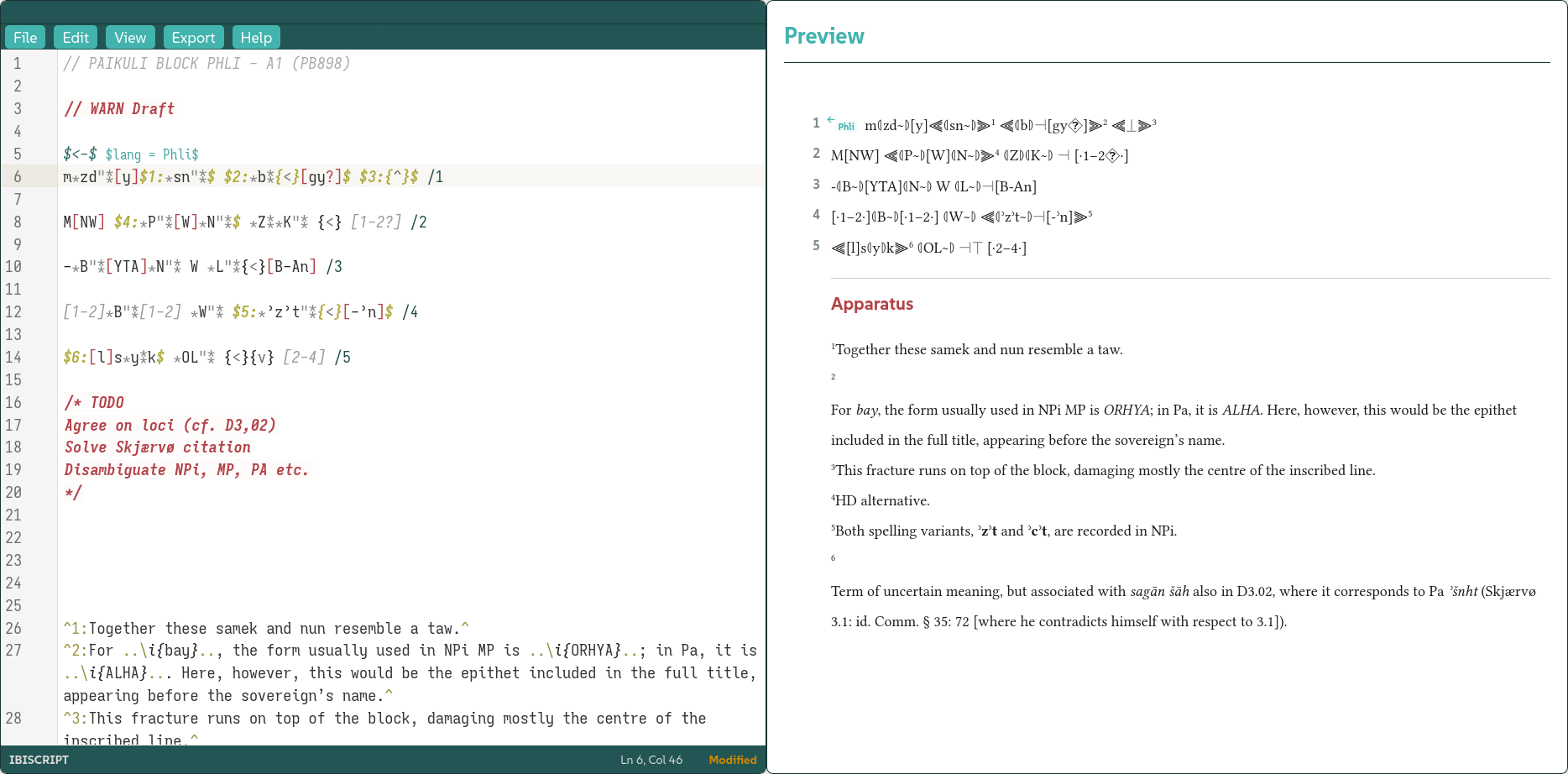
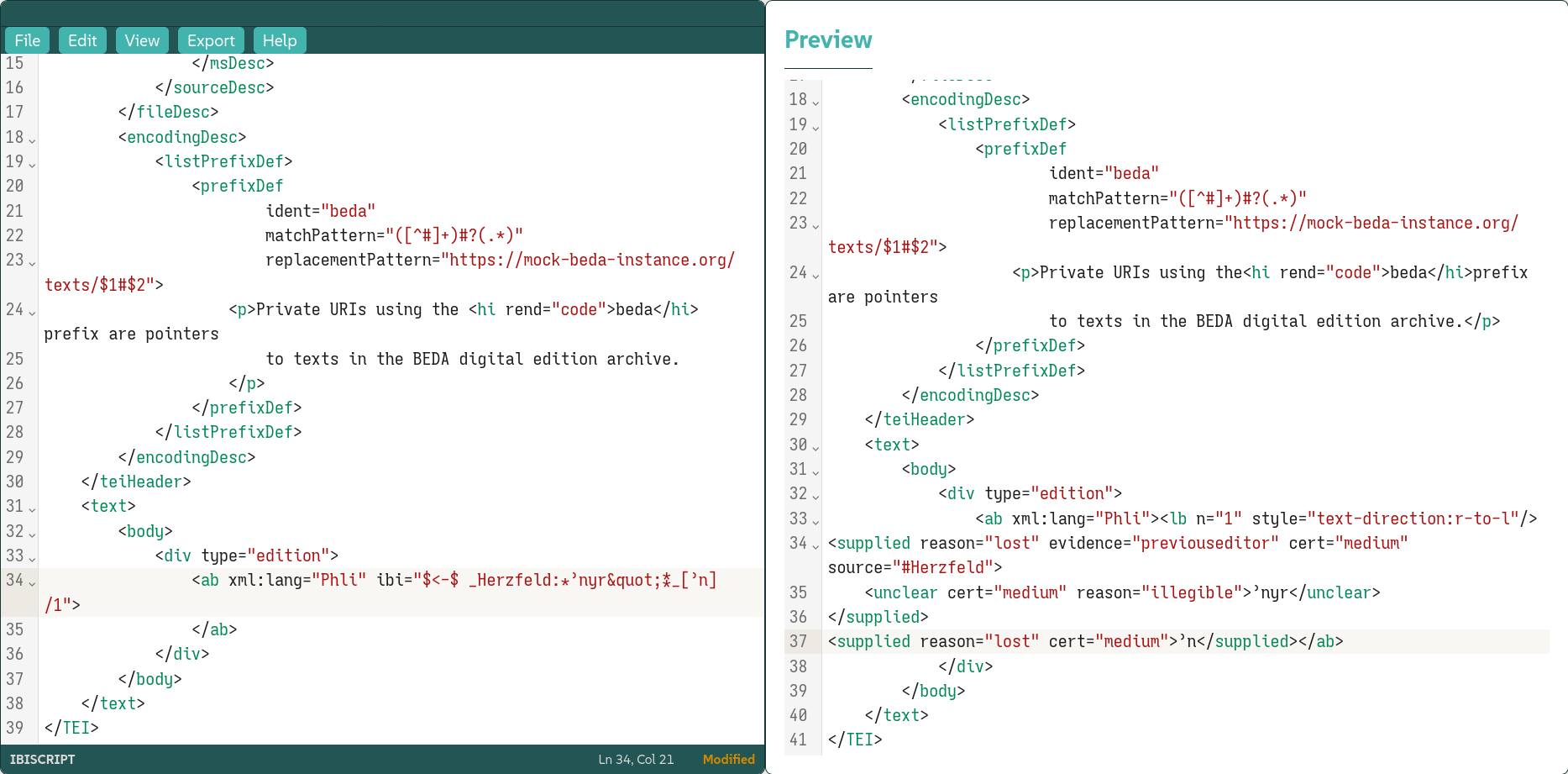
Document Management and Data Persistence
The File menu handles the import and preservation of epigraphic data. The editor allows to create and load .ibi and .xml files. To prevent the accidental loss of transcriptions due to abrupt browser tab closure, the environment integrates a protective safeguard: if unsaved changes are present, any attempt to navigate away from the page is intercepted, prompting the user for explicit confirmation.
The Download Source buttons changes depending on the type file currently contained in the editing panel (e.g. an IbiScript source in Figura 1).
Syntactic Standardisation (Format)
Accessible via the Edit menu, the Format Document function acts as a formal regulariser of the source text and is available exclusively when working in IbiScript mode (.ibi). Without altering the semantic value of the readings or critical marks entered, the algorithm automatically reorganises the spacing, alignment, and indentation of the code. This operation ensures maximum readability of the source file and standardises the logical layout criteria of the document.
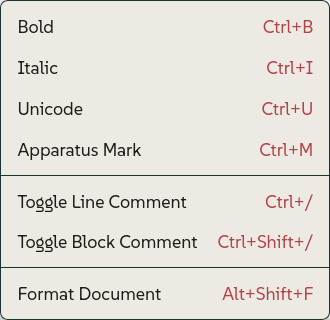
Error Tolerance in the Dynamic Preview
The preview panel offers a real-time rendering of the web-ready edition. To prevent disruptions to the philological workflow, the interface adopts a strict error-tolerance policy during parsing: should a syntactically non-compliant string be entered, the system moves into a warning state. In this mode, the preview preserves the rendering of the last valid state intact, displaying a descriptive notification alongside it to facilitate the detection and correction of the anomaly.


Visual Management and Facsimile Data Persistence
Available exclusively when working in IbiScript mode (.ibi), the facsimile panel allows precise geometric coordinates to be mapped onto the lines of the inscription text. The user is not required to write the configuration syntax manually: the editor automatically generates and updates a dedicated metadata block as soon as a region is drawn or resized using the mouse on the image. This data block ensures the persistence and portability of the visual anchoring directly within the source file.
An example of a block automatically generated by the graphical interface:
$image:
url = paikuli-block.png;
categ = museum;
regions = [
1 = 0.042501, 0.083288, 0.905037, 0.198611;
2 = 0.052631, 0.364167, 0.892105, 0.242778;
3 = 0.044736, 0.701359, 0.902631, 0.182083;
];
$
Within this structure, the url field identifies the visual resource, cat defines the archaeological or museum category of the image, and the reg array stores the geometric regions (normalised on a decimal scale) indexed according to their respective inscription line number.
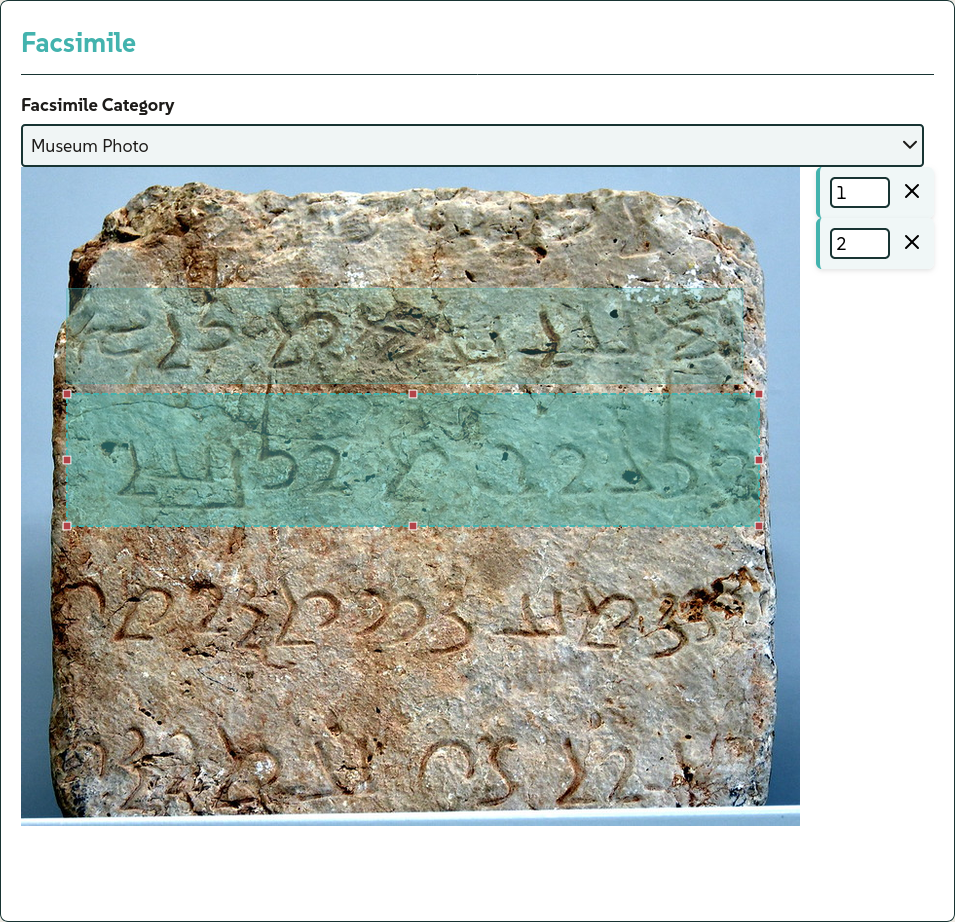
Exporting to Scientific Dissemination Formats
The Export menu adapts its available options according to the active mode:
- In IbiScript mode, it allows the conversion of the source file into six standard formats for research and publishing:
- pure Unicode text for elementary diplomatic editions;
- HTML for direct publication on the web portal;
- EpiDoc XML to ensure data interoperability according to international Digital Humanities criteria;
- JSONL for relational analysis and high-performance querying via SQL engines (e.g. DuckDB);
- Typst and PDF, the latter being compiled directly by the server from the former, delivering a high-definition, print-ready typographic document.
- In EpiDoc XML mode, export is restricted solely to pure EpiDoc, which in practice constitutes a direct transpilation operation.
Editor Keyboard Shortcuts
| Shortcut | Function |
|---|---|
Alt + Shift + F | Format and standardise syntax |
Alt + I | Toggle facsimile panel |
Alt + P | Toggle preview panel |
Ctrl + B | Format as bold |
Ctrl + I | Format as italic |
Ctrl + Shift + I | Load facsimile image |
Ctrl + N | Create a new IbiScript file |
Ctrl + Shift + N | Create a new EpiDoc XML file |
Ctrl + O | Open local file |
Ctrl + S | Save changes |
Ctrl + Shift + S | Save document as |
Ctrl + P | Export directly to PDF document |
Ctrl + U | Insert characters through Unicode aliases or codepoints |
F11 | Toggle fullscreen editor workspace |
F1 | Open official documentation in a new tab |
Technical Catalogue of Symbols
Systematic reference tables associating each epigraphic sign or delimiter with its Unicode code, providing the descriptive name, the code, and, where applicable, usage contexts or explanatory notes.
Output Delimiters
| Sign | Name | Unicode | Construct |
|---|---|---|---|
( | Left Parenthesis | U+0028 | Abbreviation, Cite |
) | Right Parenthesis | U+0029 | Abbreviation, Cite |
[ | Left Square Bracket | U+005B | Supplied, Gap |
] | Right Square Bracket | U+005D | Supplied, Gap |
⦃ | Left White Curly Bracket | U+2983 | Choice |
⦄ | Right White Curly Bracket | U+2984 | Choice |
⦇ | Z Notation Left Image Bracket | U+2987 | Unclear |
⦈ | Z Notation Right Image Bracket | U+2988 | Unclear |
⟦ | Mathematical Left White Square Bracket | U+27E6 | Erasure |
⟧ | Mathematical Right White Square Bracket | U+27E7 | Erasure |
〈 | Left-Pointing Angle Bracket | U+2329 | Omitted |
〉 | Right-Pointing Angle Bracket | U+232A | Omitted |
⸤ | Bottom Left Half Bracket | U+2E24 | PreviousSeen |
⸥ | Bottom Right Half Bracket | U+2E25 | PreviousSeen |
⧵ | Reverse Solidus Operator | U+29F5 | Ligature |
⧷ | Reverse Solidus with Horizontal Stroke | U+29F7 | Ligature |
⸂ | Left Substitution Bracket | U+2E02 | Addition |
⸃ | Right Substitution Bracket | U+2E03 | Addition |
⸄ | Left Dotted Substitution Bracket | U+2E02 | Correction |
⸅ | Right Dotted Substitution Bracket | U+2E03 | Correction |
⫷ | Triple Nested Less-Than | U+2AF7 | ApparatusMark |
⫸ | Triple Nested Greater-Than | U+2AF8 | ApparatusMark |
Special Stop Characters
| Sign | Name | Unicode |
|---|---|---|
\n | Line Feed (LF) | U+000A |
! | Exclamation Mark | U+0021 |
# | Number Sign | U+0023 |
$ | Dollar Sign | U+0024 |
/ | Solidus | U+002F |
( | Left Parenthesis | U+0028 |
) | Right Parenthesis | U+0029 |
* | Asterisk | U+002A |
⁎ | Low Asterisk | U+204E |
⁑ | Two Asterisks Aligned Vertically | U+2051 |
% | Percent Sign | U+0025 |
‰ | Per Mill Sign | U+2030 |
+ | Plus Sign | U+002B |
‡ | Double Dagger | U+2021 |
⟦ | Mathematical Left White Square Bracket | U+27E6 |
⟧ | Mathematical Right White Square Bracket | U+27E7 |
= | Equals Sign | U+003D |
≠ | Not Equal To | U+2260 |
- | Hyphen-Minus | U+002D |
< | Less-Than Sign | U+003C |
> | Greater-Than Sign | U+003E |
? | Question Mark | U+003F |
[ | Left Square Bracket | U+005B |
] | Right Square Bracket | U+005D |
^ | Circumflex Accent | U+005E |
_ | Low Line | U+005F |
{ | Left Curly Bracket | U+007B |
} | Right Curly Bracket | U+007D |
| | Vertical Line | U+007C |
Writing systems supported for key:value entry
List of ISO 15924 codes relating to the writing systems supported by IbiScript for the engonomic insertion of Unicode characters. The four-letter code must be entered as the identifier for the chosen writing system, followed by a colon : and the nominal aliases for each glyph, separated by commas , if more than one is to be entered (cf. Coded Signs).
All characters, including those from unsupported writing systems, can be entered using the corresponding Unicode character code.
| ISO Code | Name |
|---|---|
aghb | Caucasian Albanian |
ahom | Ahom |
arab | Arabic |
armi | Imperial Aramaic |
armn | Armenian |
avst | Avestan |
beng | Bengali |
bhks | Bhaiksuki |
brah | Brahmi |
cakm | Chakma |
cari | Carian |
chrs | Chorasmian |
copt | Coptic |
cpmn | Cypro-Minoan |
cprt | Cypriot |
cyrl | Cyrillic |
deva | Devanagari |
diak | Dives Akuru |
dogr | Dogra |
egyp | Egyptian Hieroglyphs |
elba | Elbasan |
elym | Elymaic |
ethi | Ethiopic |
geor | Georgian |
glag | Glagolitic |
gong | Gunjala Gondi |
gonm | Masaram Gondi |
goth | Gothic |
gran | Grantha |
grek | Greek |
gujr | Gujarati |
gukh | Gurung Khema |
guru | Gurmukhi |
hatr | Hatran |
hebr | Hebrew |
hluw | Anatolian Hieroglyphs |
hmng | Pahawh Hmong |
hmnp | Nyiakeng Puachue Hmong |
hung | Old Hungarian |
ital | Old Italic |
kali | Kayah Li |
kawi | Kawi |
khar | Kharoshthi |
khoj | Khojki |
knda | Kannada |
krai | Kirat Rai |
kthi | Kaithi |
latn | Latin |
lepc | Lepcha |
limb | Limbu |
lina | Linear A |
linb | Linear B |
lyci | Lycian |
lydi | Lydian |
mahj | Mahajani |
mand | Mandaic |
mani | Manichaean |
marc | Marchen |
merc | Meroitic Cursive |
mero | Meroitic Hieroglyphs |
mlym | Malayalam |
modi | Modi |
mong | Mongolian |
mtei | Meetei Mayek |
mult | Multani |
mymr | Myanmar |
nand | Nandinagari |
narb | Old North Arabian |
nbat | Nabataean |
newa | Newa |
nkoo | Nko |
ogam | Ogham |
orkh | Old Turkic |
orya | Oriya |
osma | Osmanya |
ougr | Old Uyghur |
palm | Palmyrene |
perm | Old Permic |
phag | Phags-pa |
phli | Inscriptional Pahlavi |
phlp | Psalter Pahlavi |
phnx | Phoenician |
prti | Inscriptional Parthian |
runr | Runic |
samr | Samaritan |
sarb | Old South Arabian |
shrd | Sharada |
sidd | Siddham |
sind | Khudawadi |
sinh | Sinhala |
sogd | Sogdian |
sogo | Old Sogdian |
sora | Sora Sompeng |
soyo | Soyombo |
sunu | Sunuwar |
sylo | Syloti Nagri |
syrc | Syriac |
takr | Takri |
taml | Tamil |
telu | Telugu |
tfng | Tifinagh |
thaa | Thaana |
tibt | Tibetan |
tirh | Tirhuta |
tnsa | Tangsa |
tutg | Tulu-Tigalari |
ugar | Ugaritic |
xpeo | Old Persian |
xsux | Cuneiform |
yezi | Yezidi |
zanb | Zanabazar Square |
--- | COMMON |
Glossary of terms
- Lectio (pl. lectiones) — The individual interpretative choice made by the editor in epigraphic, philological, or linguistic matters.